Home › Dotonbori & Namba
Osaka · Minami · Food
Dotonbori & Namba: a local's honest guide to Osaka's food heart
KBy Kai Sato · a 28-year Osaka local
Walked and photographed in July 2026 — every photo here is ours, taken on the day. Prices and hours change, so check the current-year details before you go.
I live in Nakanoshima, and today I did the walk I always tell visitors to do: straight down Midosuji, through Hommachi and Shinsaibashi, into Namba and Dotonbori. Every photo in this article is ours, taken on that walk. So when I say the Ebisubashi bridge was packed, I mean it was packed today — not "packed" in a stock-photo way.
Dotonbori is the canal-side food and entertainment heart of Minami — southern downtown Osaka, in Chuo-ku. The local ethos is kuidaore (食い倒れ): "eat yourself broke." Osakans say it half as a joke and half as a warning. This guide covers the whole approach, because the walk down is half the point — and for where Dotonbori sits in the bigger picture, see our full Osaka rankings.
Dotonbori is loud, packed, unapologetically touristy — and still worth it. The neon canal, the Glico sign, and a hot paper boat of takoyaki are the Osaka experience, full stop. Just know what you're walking into: the stalls with the biggest signboards on the main drag charge tourist prices, and the best-value food is often one block off it. Come once in the evening for the spectacle, keep a hand on your bag, and don't try to eat everything in one night. That's not honesty puncturing the hype — it's the hype being mostly deserved, with an asterisk.
Most visitors ride the Midosuji subway line and pop out at Namba like a mole. Fine. But if you have 40–60 minutes, walk it. Midosuji is Osaka's grand central boulevard — wide, clean, lined with ginkgo trees and luxury flagships. It's the calm, dignified face of a city famous for being neither.
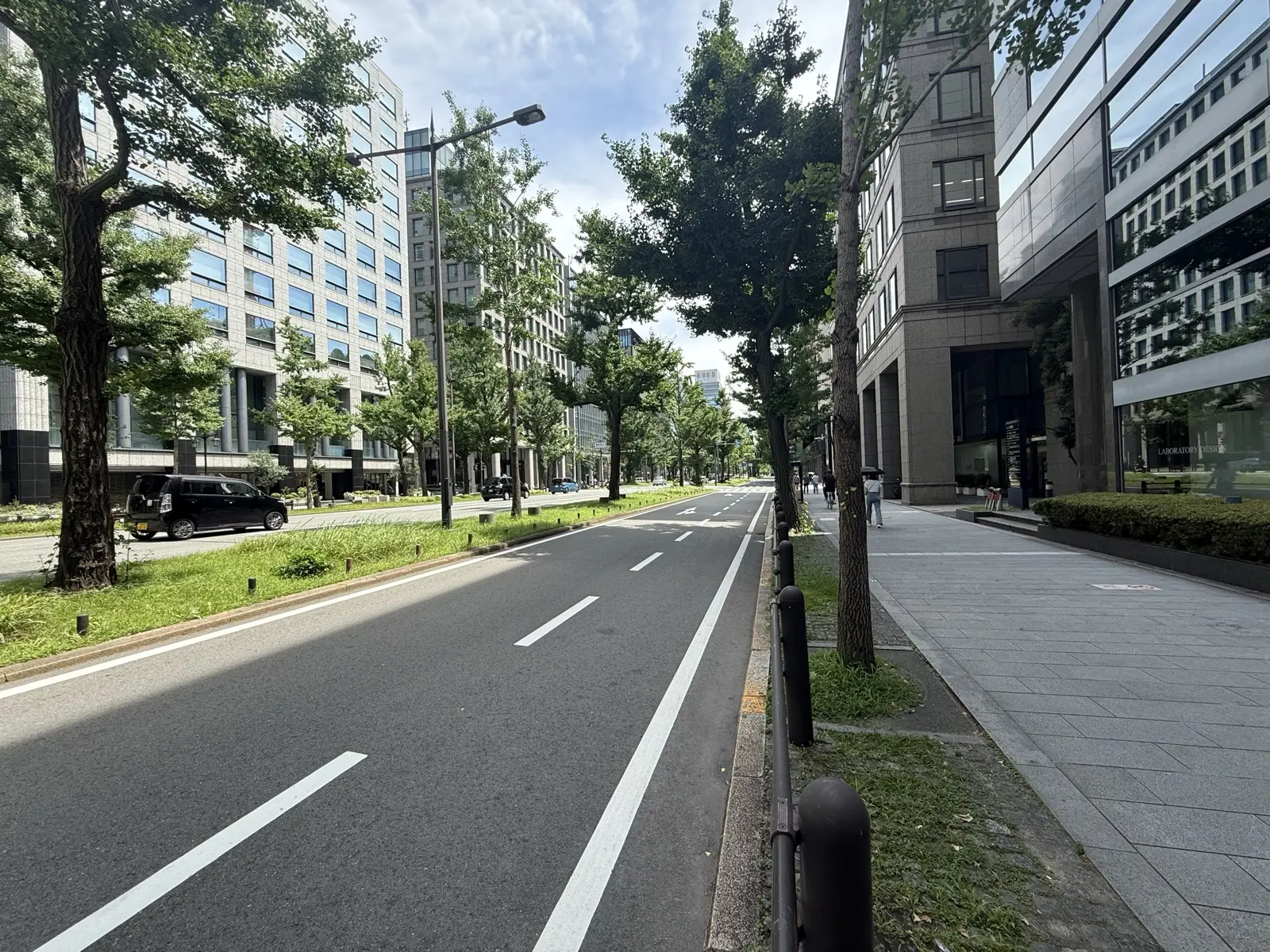
Two free, quiet stops hide in plain sight along the way, and almost no tourists notice either one.
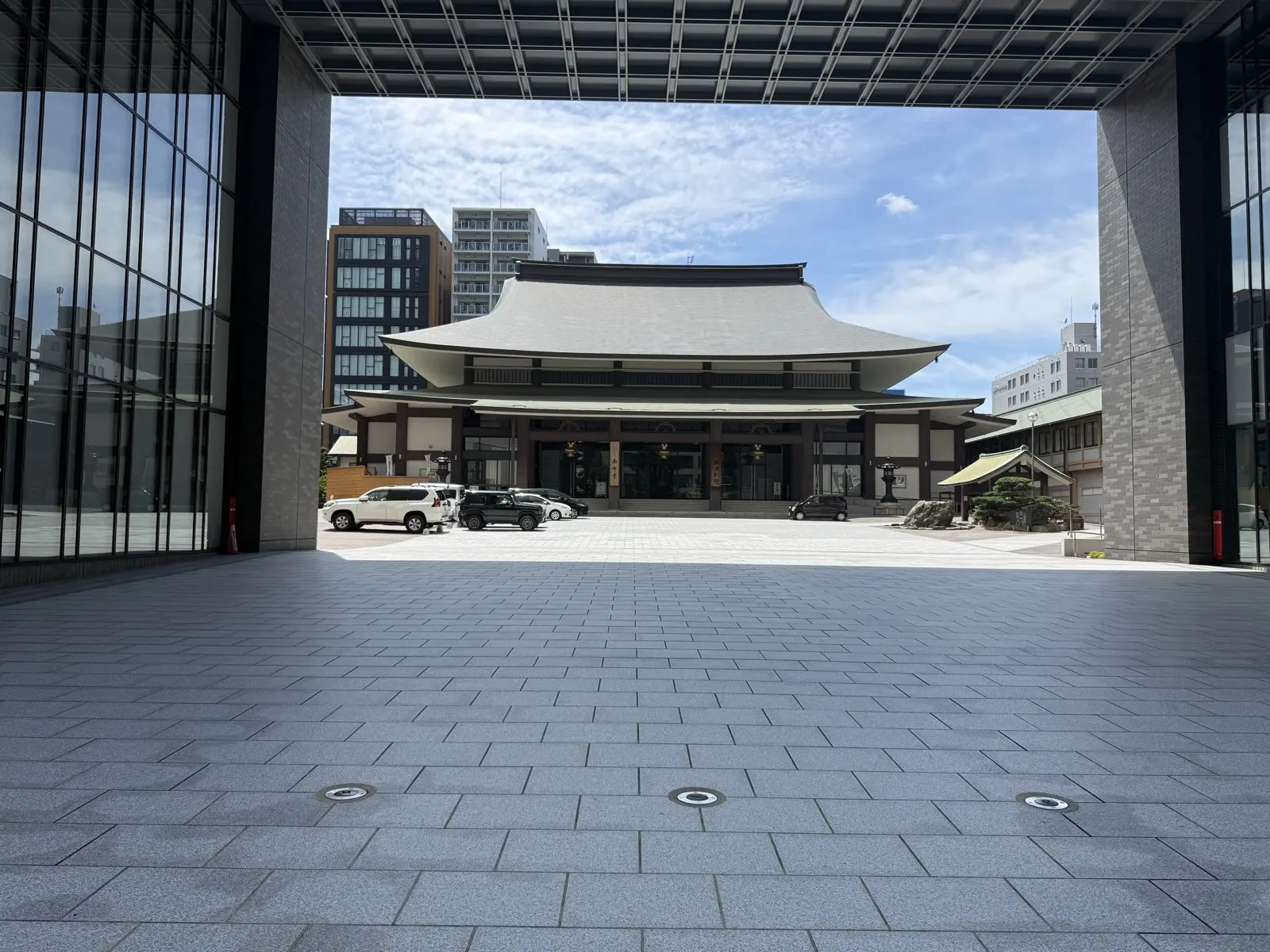
Kita-Mido (北御堂, formally Honganji Tsumura Betsuin) is a large Jodo-Shinshu Buddhist temple sitting directly on Midosuji, framed by a modern building. It's free, it's genuinely quiet, and there's a small free museum inside. The street "Midosuji" is literally named after the Mido temples. Ten minutes here resets your brain before the sensory assault downstream.
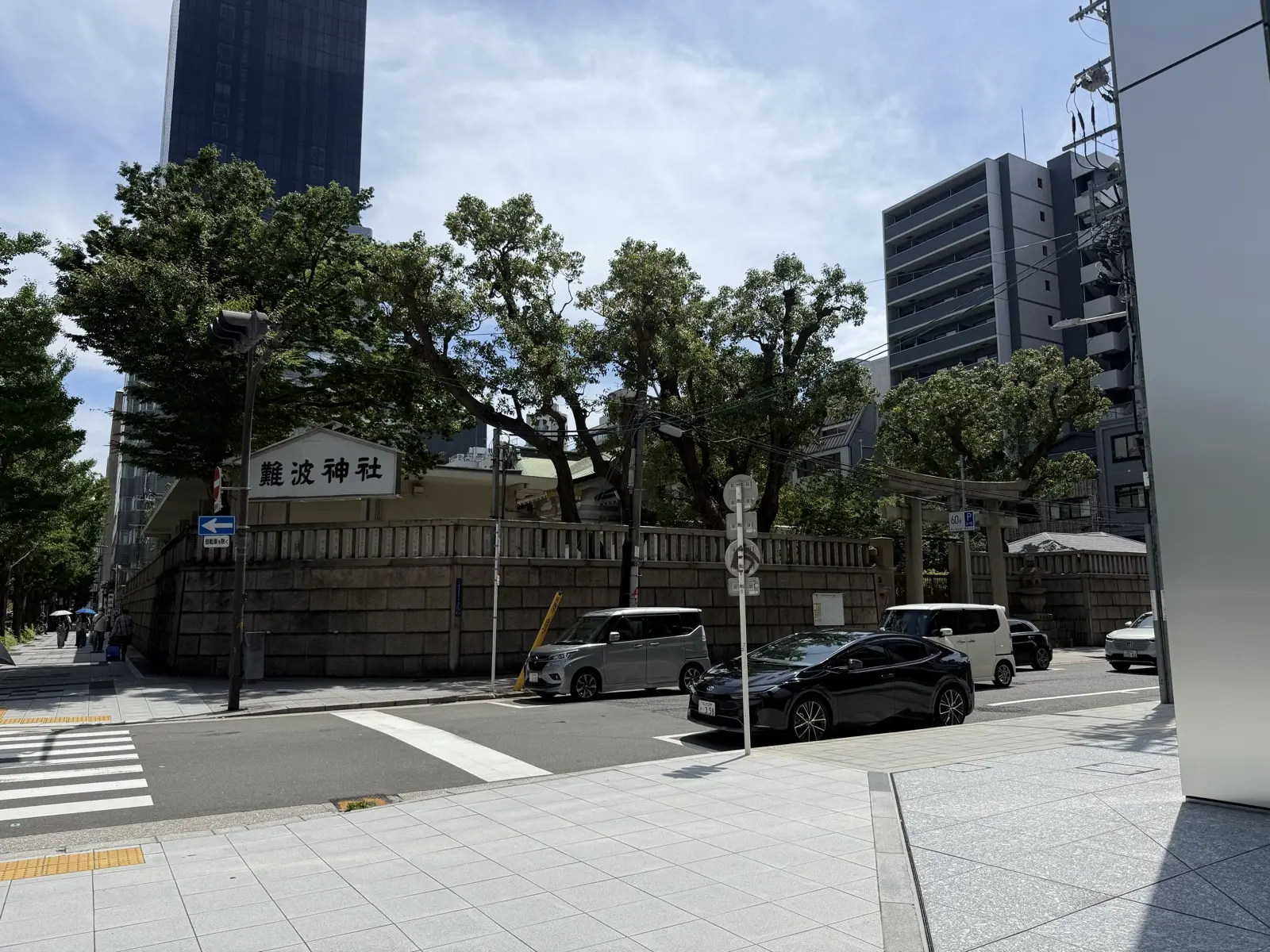
A few blocks further south, Namba Shrine (難波神社) is a pocket of trees and vermilion tucked between office towers. Also free, also quiet. If you like the contrast of old-Japan-inside-new-Japan, this is the easiest version of it you'll find all day.
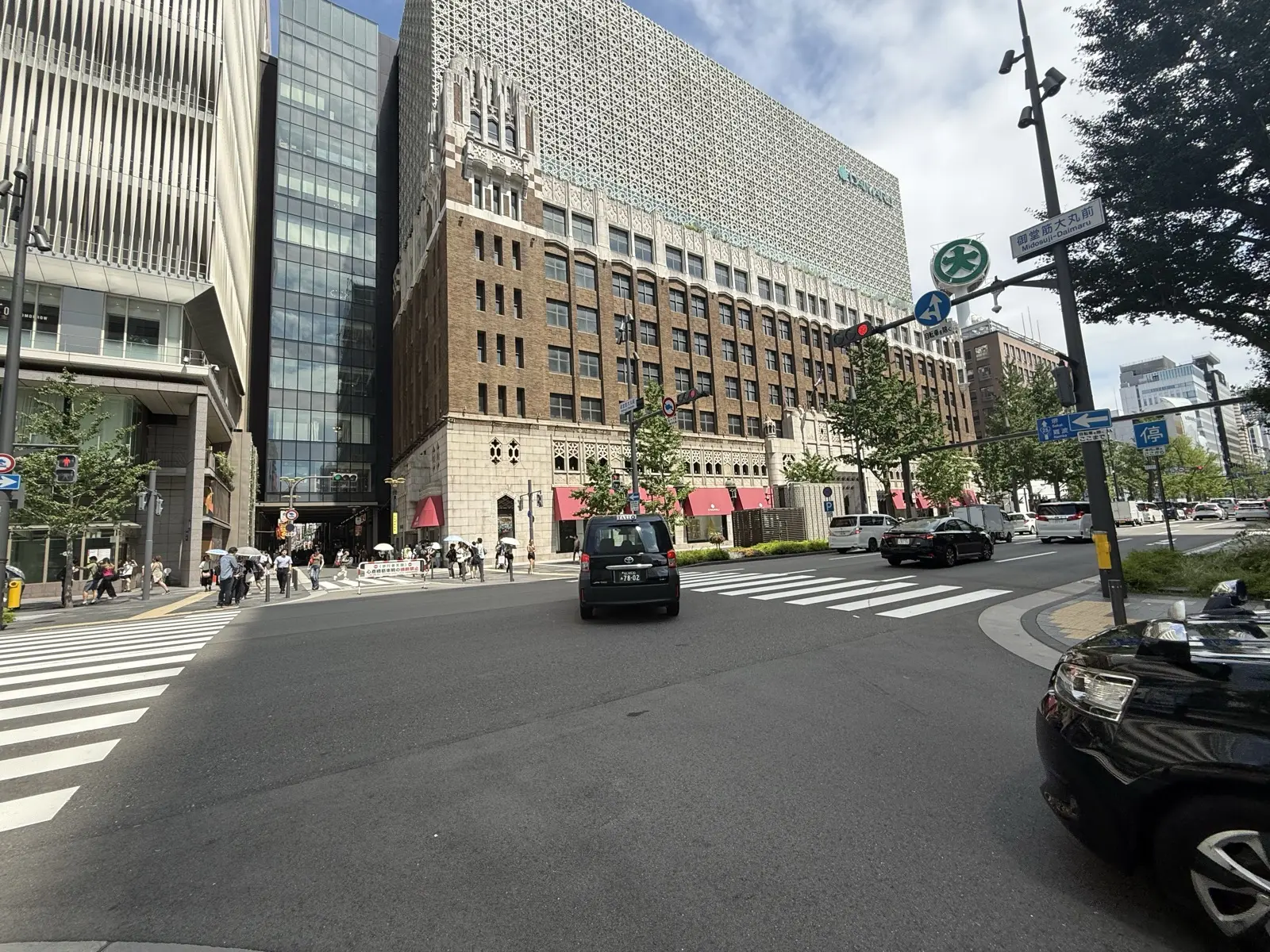
At Shinsaibashi you hit Daimaru — the ornate 1933 building by the architect William Merrell Vories. Even if department stores bore you, look up at the facade. It's one of the most beautiful buildings in Osaka, and nobody photographs it because it's "just a shop."
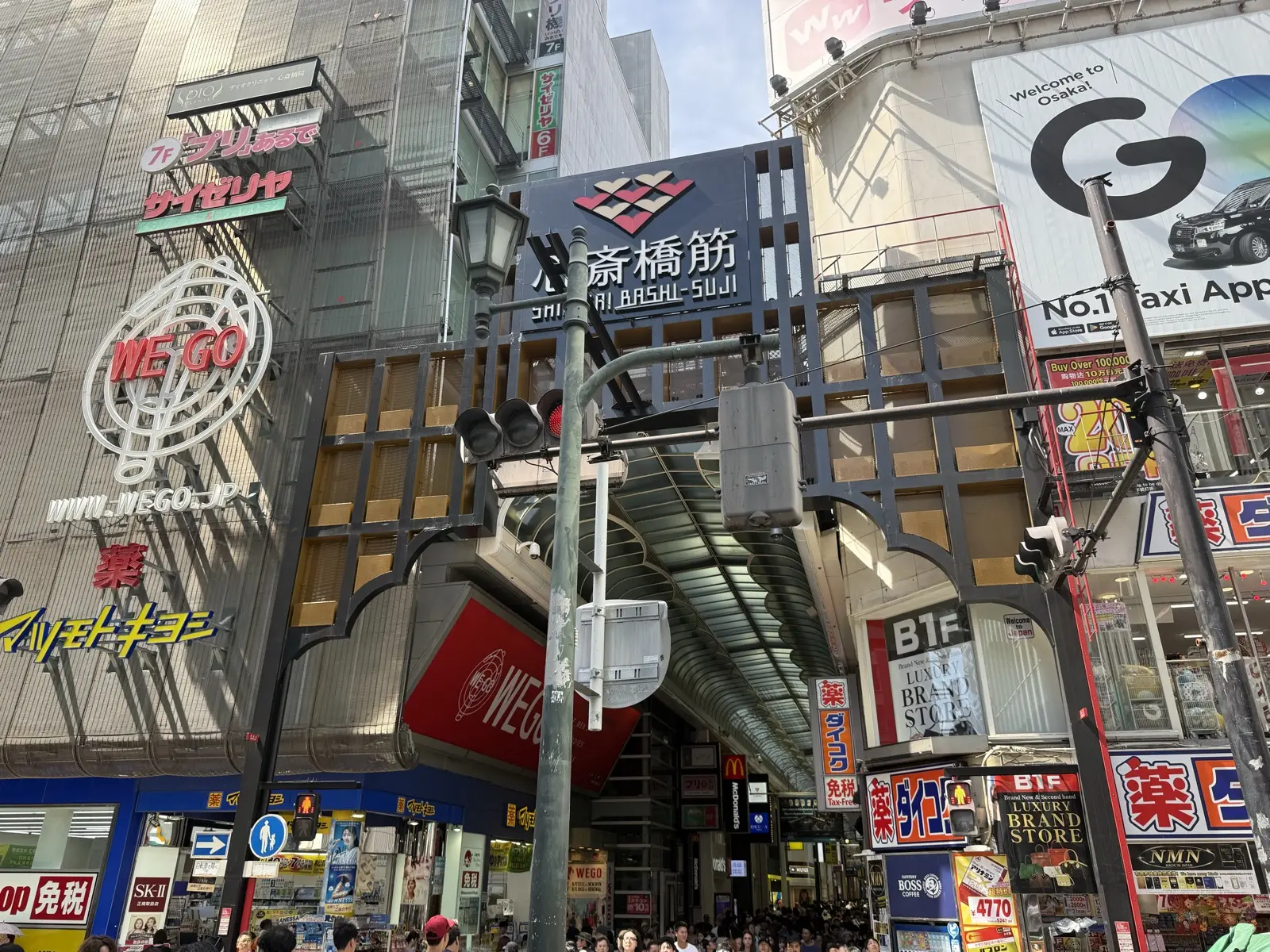
From here you have a choice. Stay on Midosuji (trees, luxury brands, breathing room) or duck into Shinsaibashi-suji, the long covered shopping arcade running parallel, straight down toward Dotonbori. The arcade is louder, denser, and more fun if you like people-watching. It also funnels you directly onto Ebisubashi bridge — which is exactly why it gets rammed.
Namba is one of Japan's great transport tangles — multiple stations, endless underground passages. The landmark to orient by is the Nankai Building: the grand arched Art-Deco block that houses Takashimaya department store and Nankai Namba Station. The open plaza in front, with people resting on the steps, is the unofficial meeting point of southern Osaka.
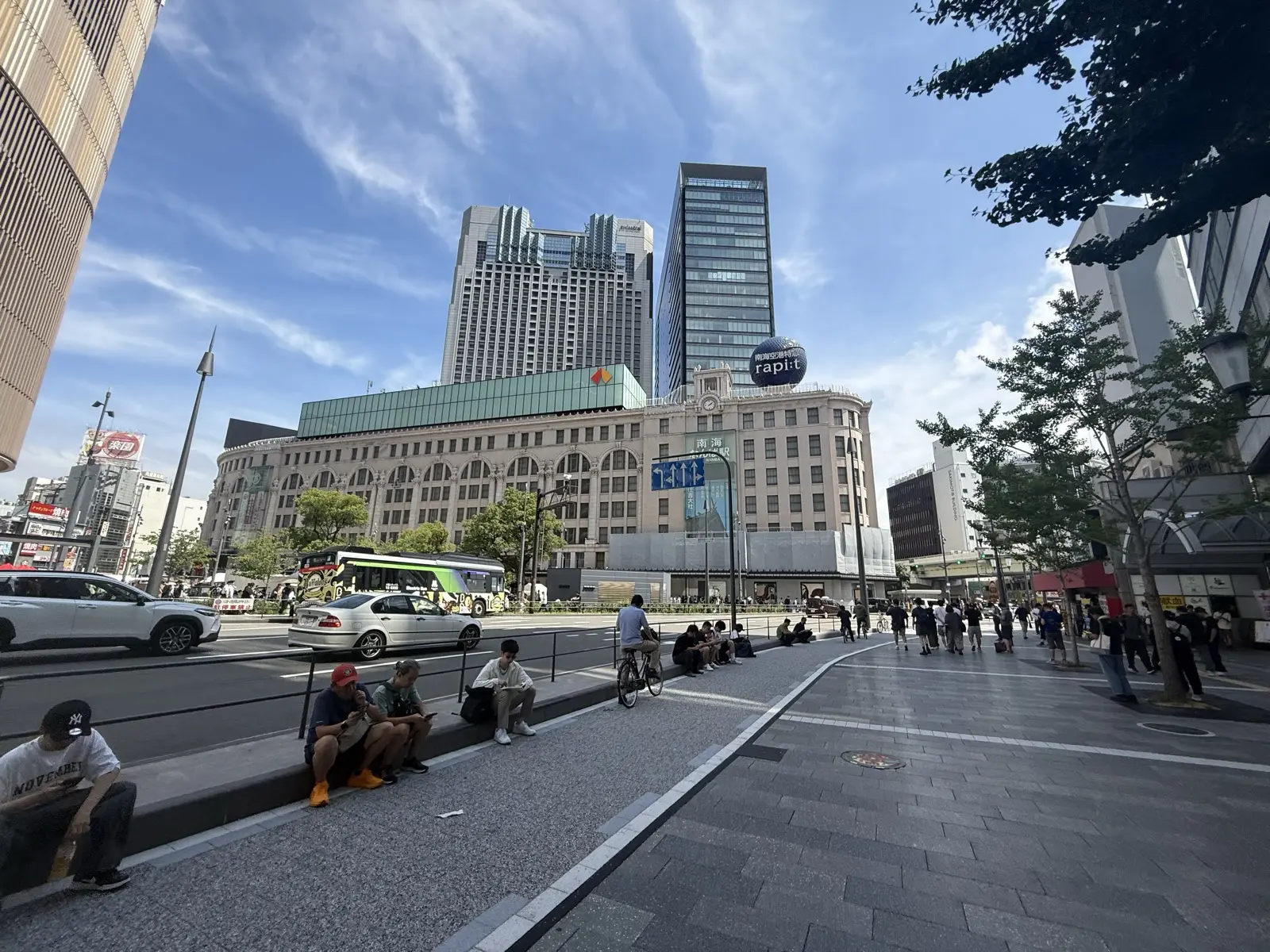
Practical note: Nankai Namba is the gateway to Kansai Airport. If you're flying in or out of KIX, this station is probably in your itinerary whether you plan it or not — here's exactly how that works. Takashimaya's basement food hall (depachika) is also a legitimately good place to buy food when the street stalls are mobbed.
Arriving from KIX with a suitcase? Sort this out before you're standing in the concourse. There are coin lockers around Namba and Nankai Namba Station, but they fill up fast at peak times — by mid-morning on a busy day you'll walk past bank after bank of red "occupied" lights. The reliable fixes are a staffed luggage-storage counter, or better, Japan's luggage-forwarding service (takkyubin), which sends your bag from the airport straight to your hotel so you arrive in Dotonbori hands-free. And a very Osaka tip: if you need more space for the shopping haul on the way home, the giant Don Quijote on the canal even sells cheap suitcases and carry-ons. Dragging a roller bag across Ebisubashi at 6pm is a mistake you only make once.
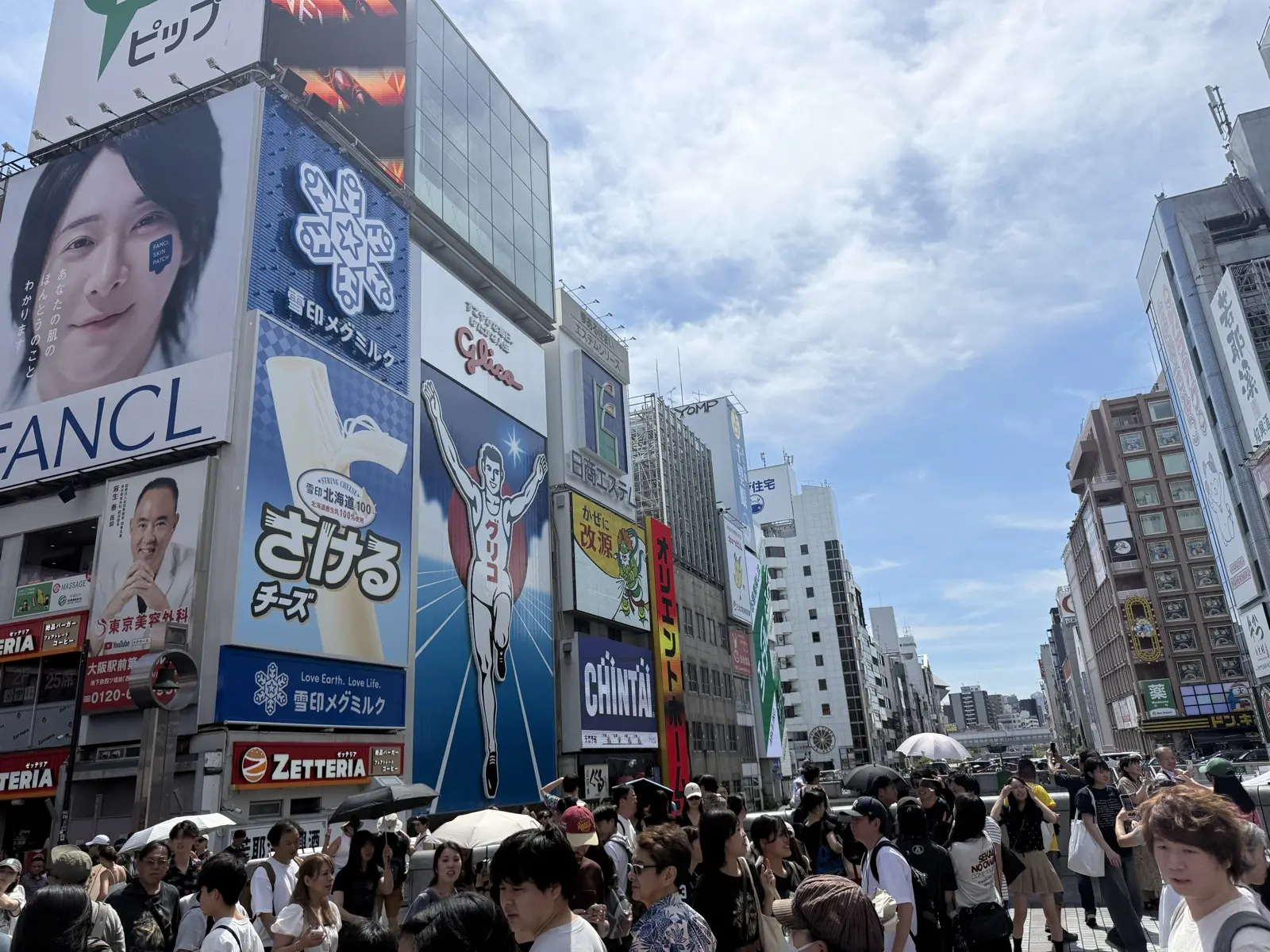
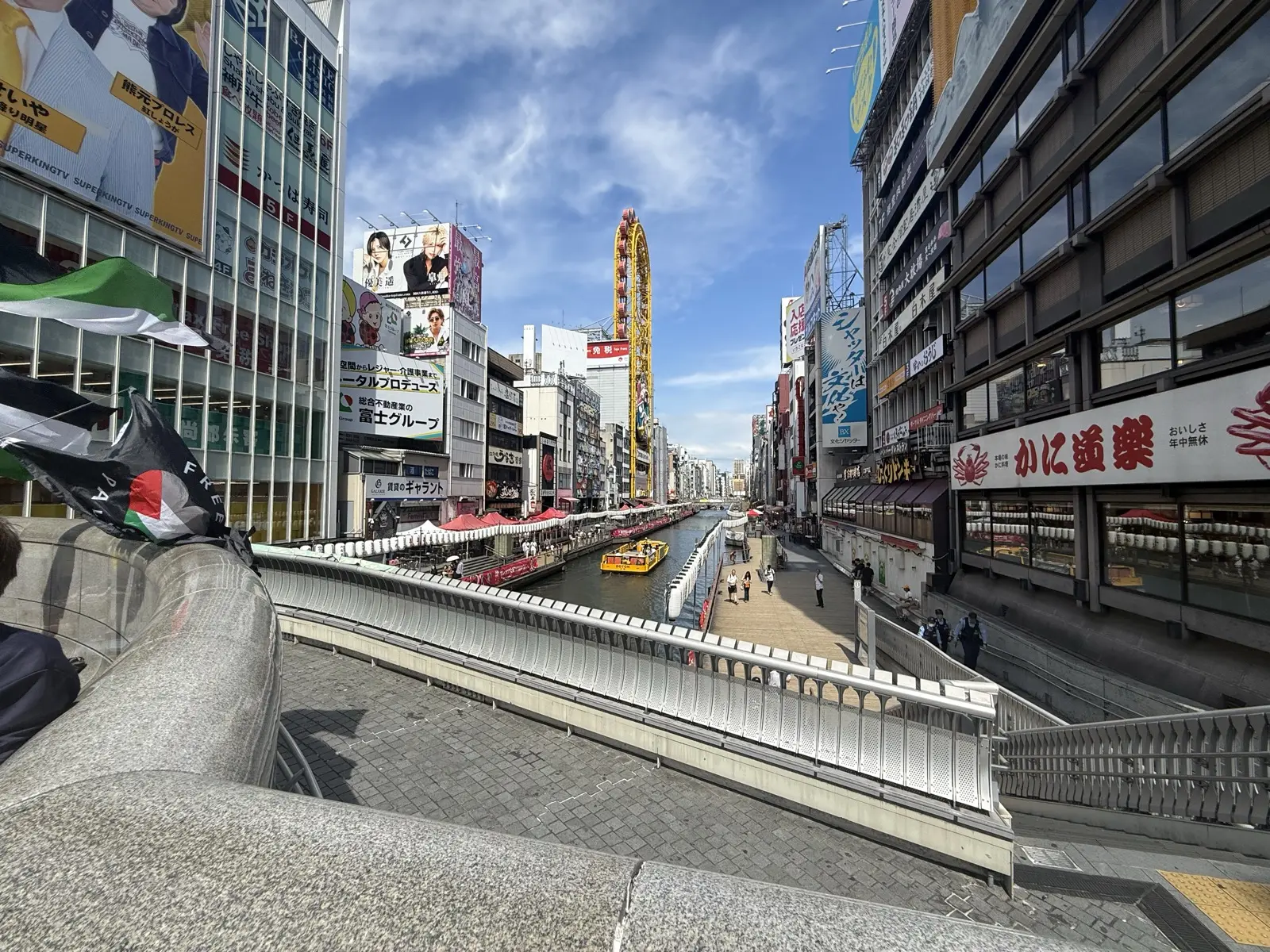
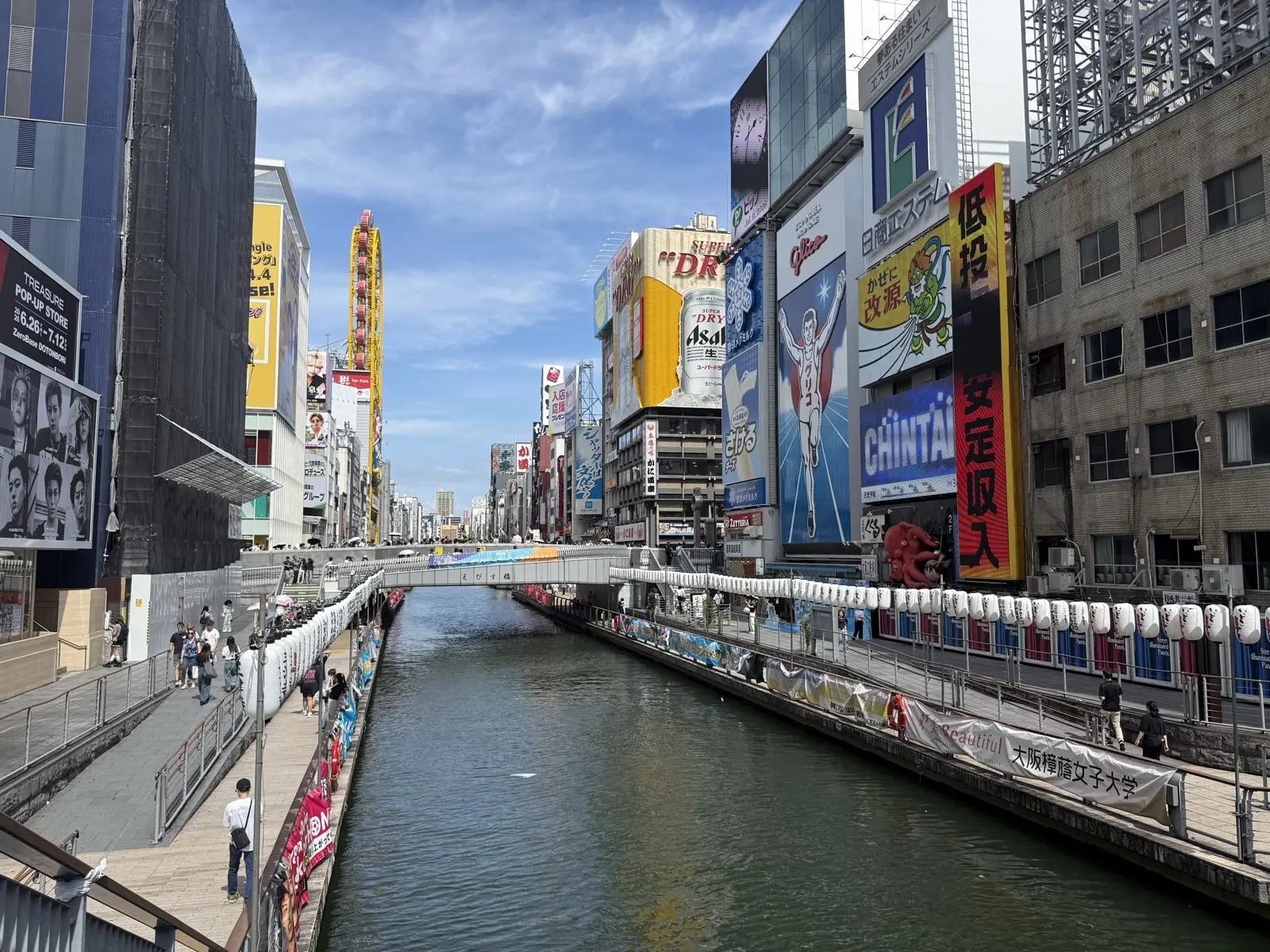
Cross Ebisubashi bridge and there it is: the Glico running man, blazing over the canal. He's been an Ebisubashi landmark since 1935 (the current version is LED), and this is THE Osaka photo. It costs nothing. That's genuinely rare for a city's number-one icon.
The catch is the bridge itself. It is extremely crowded — today it was shoulder to shoulder, everyone angling for the same shot. My honest advice: get your photo, then get off the bridge. The better views of the canal are from the Tombori Riverwalk below, where you can actually stand still.
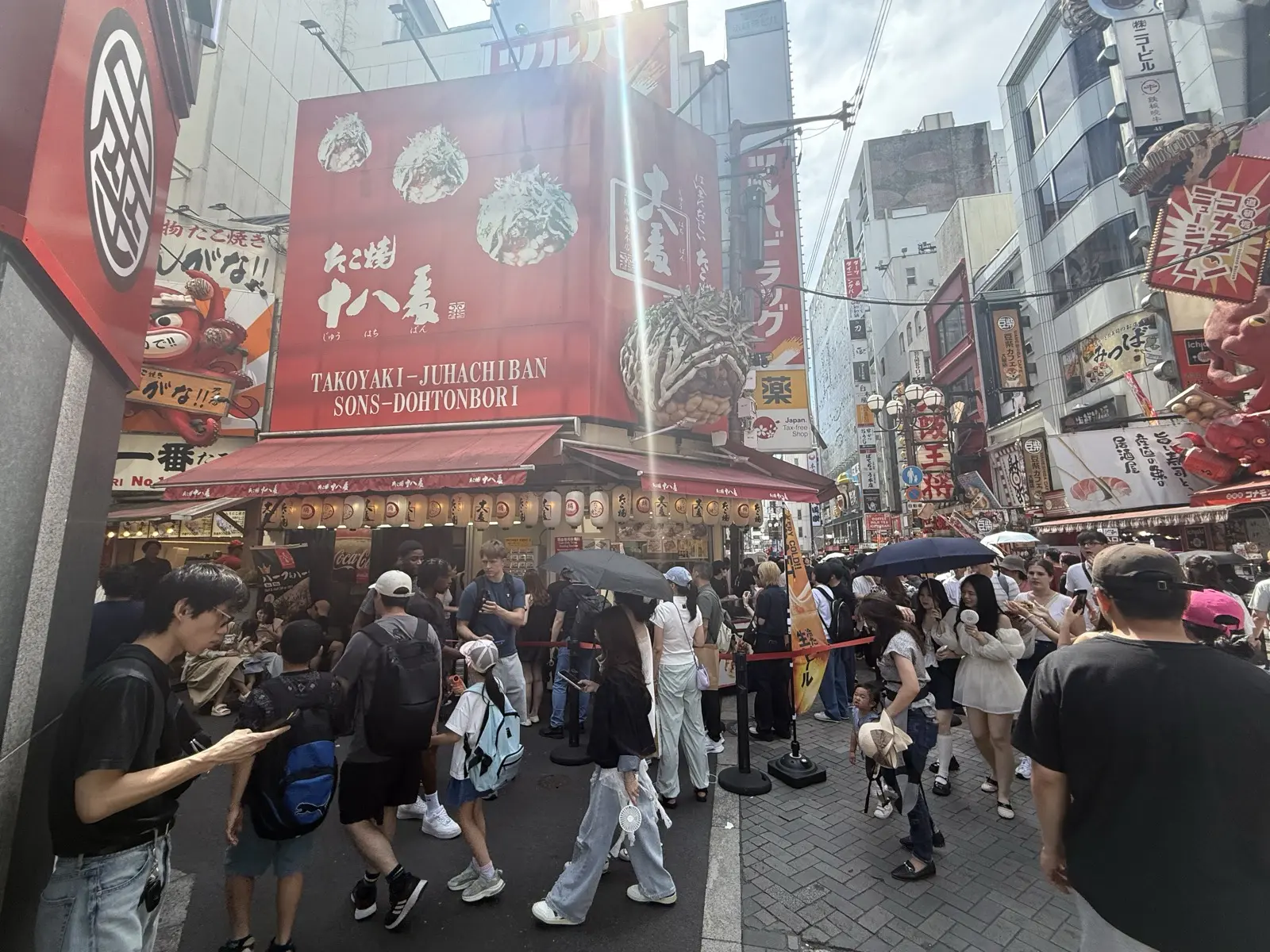
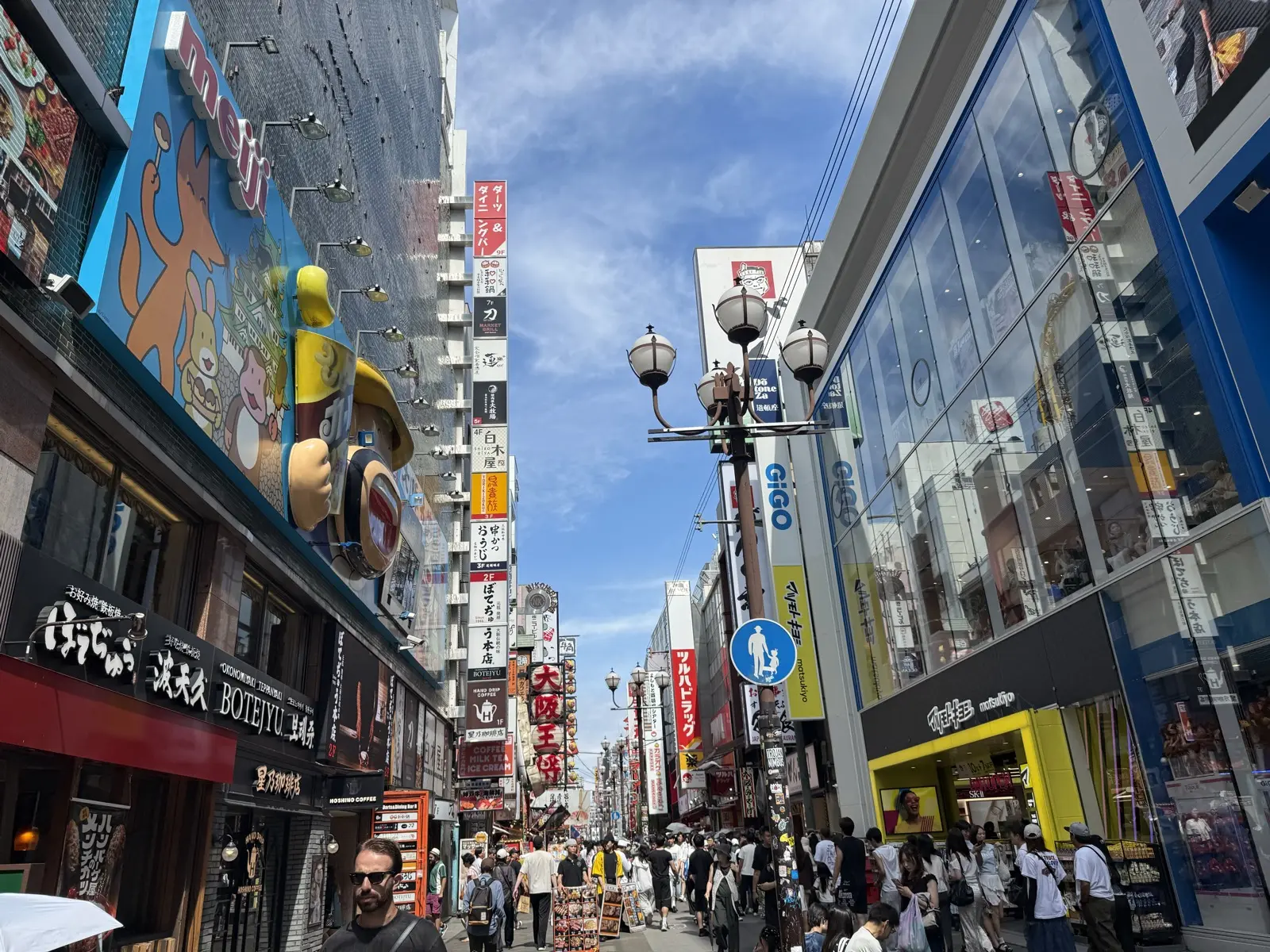
And this is what the main street looks like on a normal day. Not a festival. A normal day.
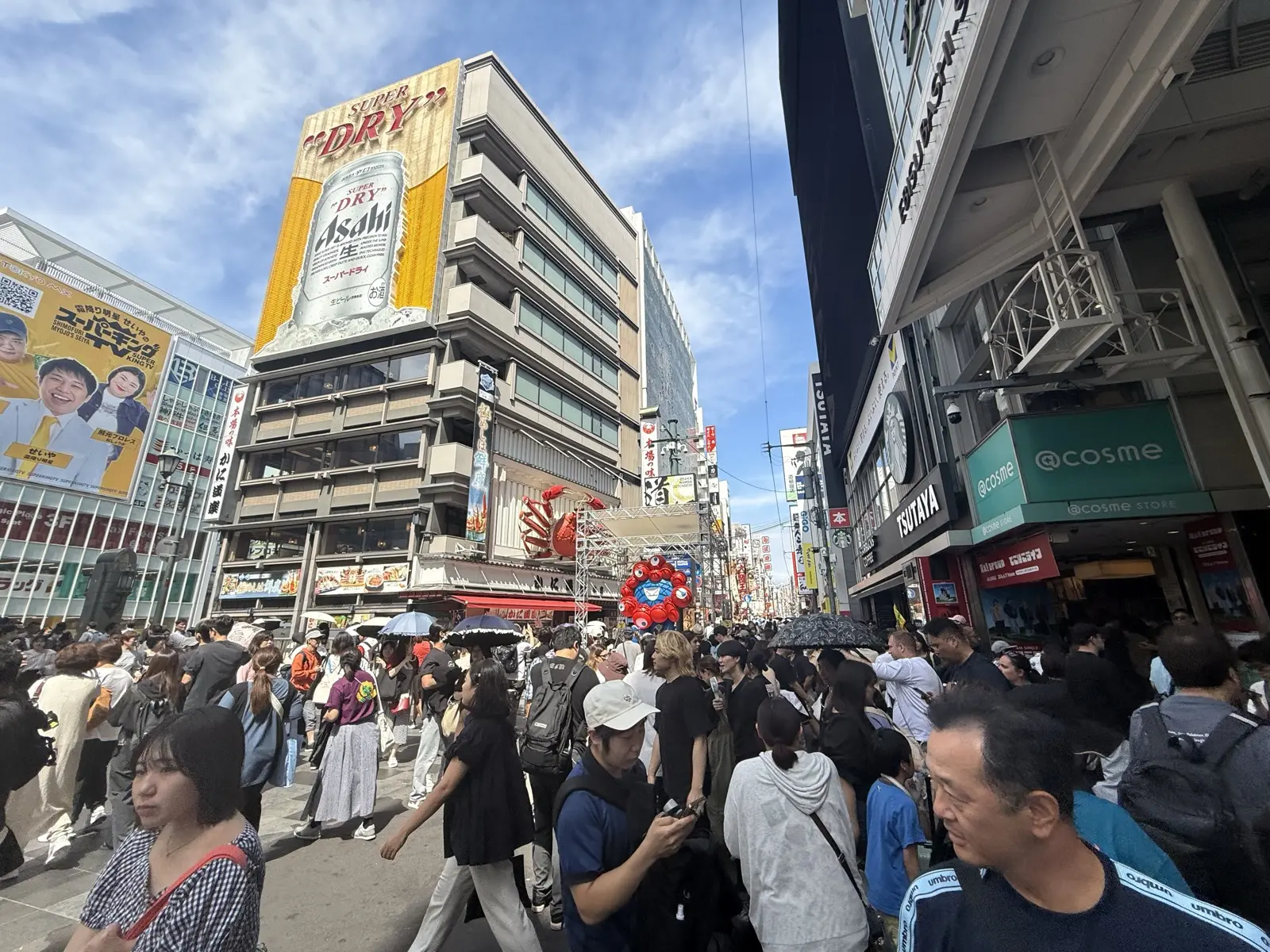
Keep your bag zipped and in front of you in this crush — not because Osaka is dangerous (it isn't, by any big-city standard), but because this density is exactly where phones get bumped out of hands.
The Tombori River Cruise — the yellow boat — is a short narrated loop on the canal, about 20 minutes (a modest fee on its own). It's a fun, low-effort way to see the neon walls from water level, and it's one of the experiences included on the Osaka Amazing Pass, which changes the value math completely — here's whether that pass is worth it. If you're paying standalone, it's a nice-to-have, not a must.
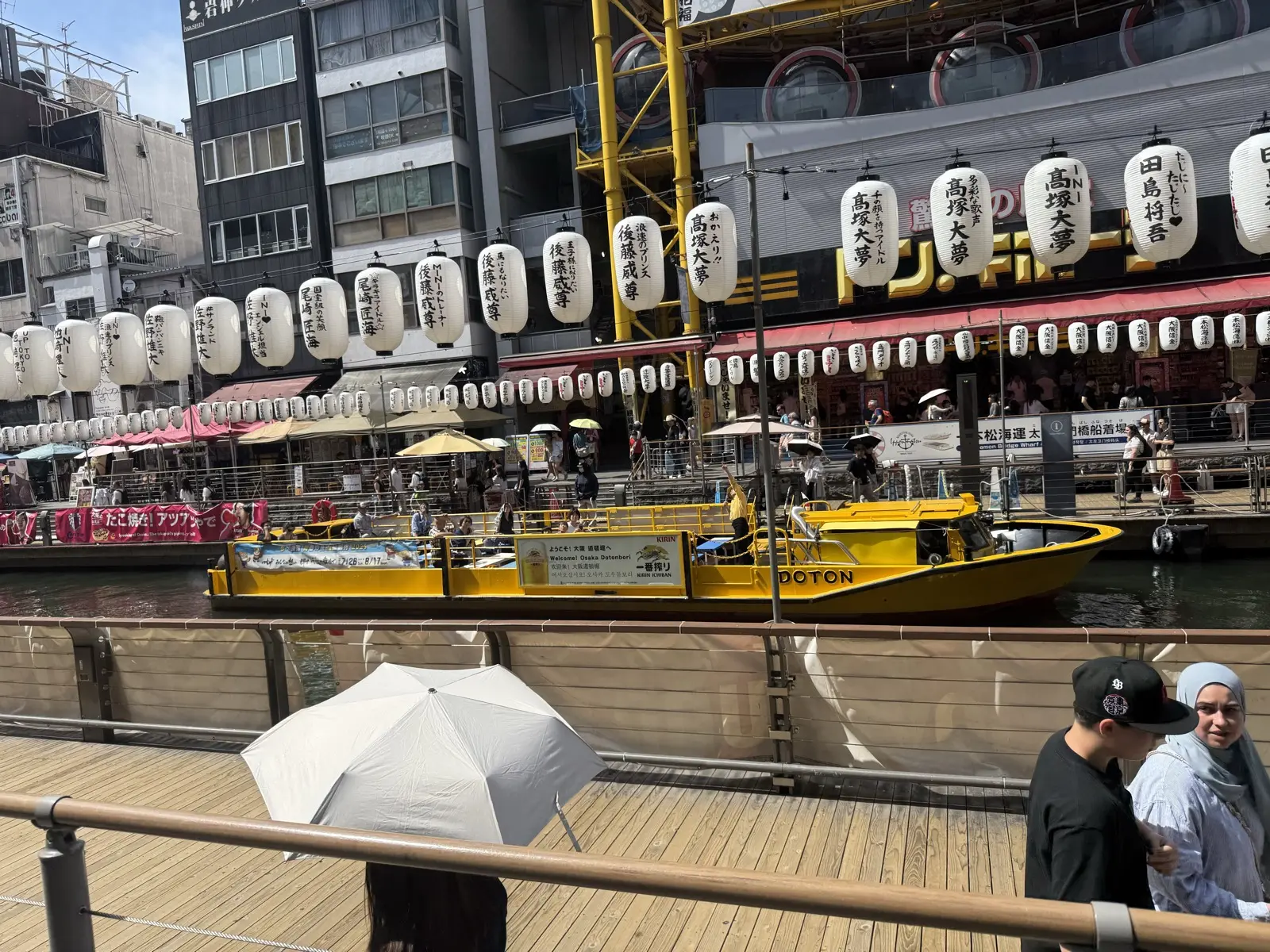
Want the neon from water level? You can reserve the short Dotonbori canal cruise in advance — handy in peak season when the daytime slots sell out. Prefer a longer loop of Osaka's waterways? There's a wider city cruise too.
Dotonbori canal cruise on Klook → Osaka city cruise →Looming over the canal, the Don Quijote Dotonbori building carries the oval "Ebisu Tower" ferris wheel — billed as the world's first oval Ferris wheel, and one of the strangest-looking rides in Japan. It's about a 15-minute turn (roughly ¥600; the entrance is up on the 3rd–4th floor of the Don Quijote store) and it runs late into the evening. It closes for maintenance on Tuesday mornings, so check the day's hours before you build plans around it.
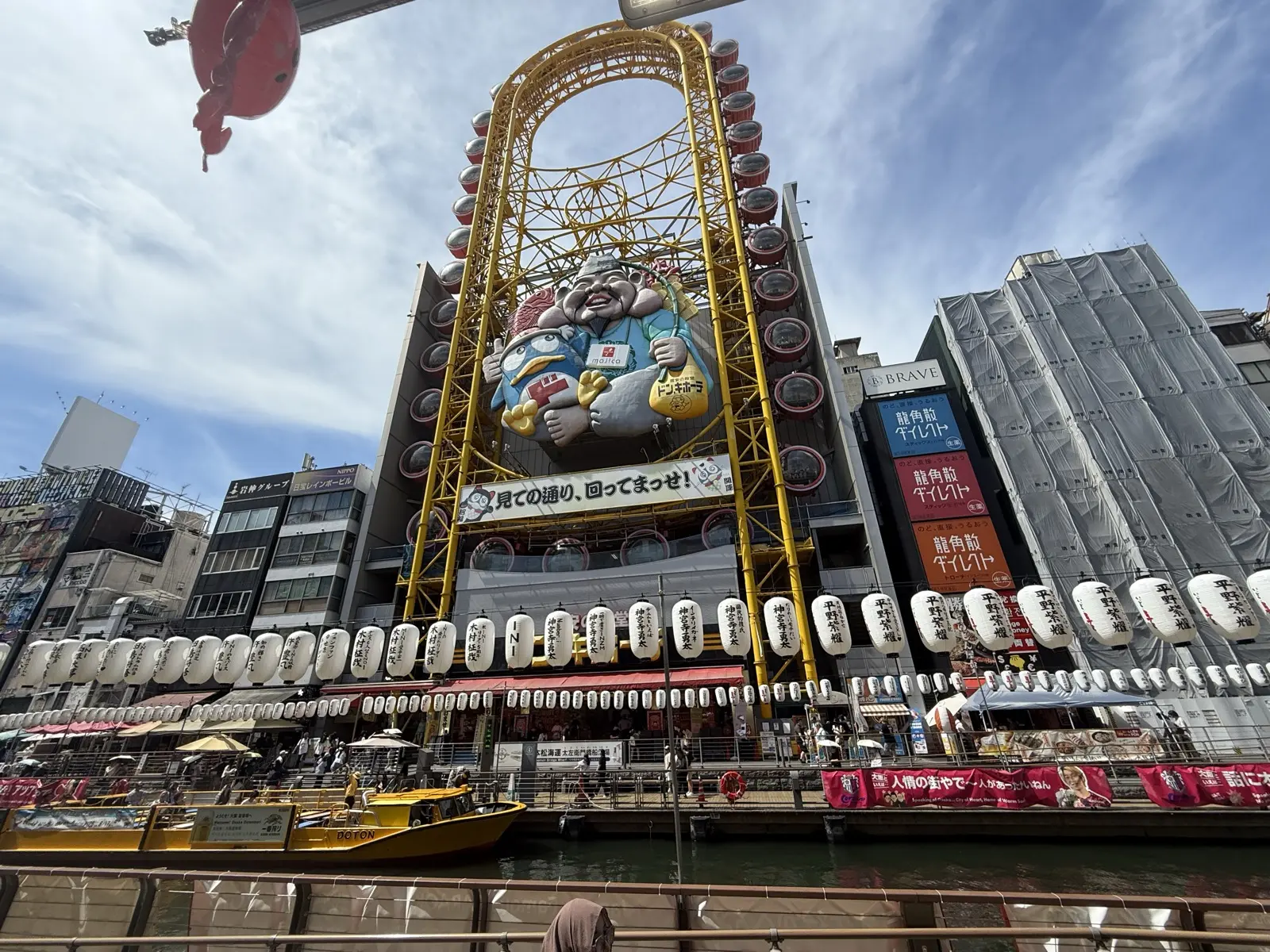
One more thing about that Don Quijote: it's not only a ferris-wheel pedestal. It's a multi-floor maze of snacks, cosmetics and souvenirs, open around the clock, and it offers tax-free shopping for foreign passport holders above a minimum spend — bring the physical passport, not a photo of it. The drugstores along Shinsaibashi-suji run the same scheme. If you're buying the Kit-Kat-and-cosmetics haul anyway, the tax-free counter is real money back.
For the full panorama — neon on both banks, the Glico man at the far end — walk east along the riverwalk and look back. This is the shot everyone actually wants, and most people never leave the bridge to find it.
Here's what almost nobody standing on Ebisubashi realises: one block south of the noise is a tiny stone-paved alley where Dotonbori's volume drops to almost nothing. Hozenji Yokocho (法善寺横丁) is lantern-lit, barely wide enough for two people to pass, and lined with small traditional bars and restaurants. It's old Minami — the version that existed before the neon.
At its heart is Hozenji temple's Mizukake Fudo, a statue so completely covered in soft green moss you can barely make out the figure underneath. The moss is the point: visitors ladle water over it when they make a wish, and generations of splashing have turned it green. Join in — it's free, it's welcomed, and it's the gentlest thing you'll do all evening.
My honest take: if Dotonbori is the photo you came for, Hozenji Yokocho is the memory you leave with. Go after the canal, when the lanterns are lit — it's the best value-for-effort detour in this whole guide, and it costs you forty metres of walking.
Dotonbori is also, honestly, at its best after dark, when the canal turns into a mirror for all that neon — more on that in our guide to Osaka at night.
Osaka's two signature street foods are takoyaki (octopus balls) and kushikatsu (deep-fried skewers). Dotonbori has both in absurd density, plus ramen, okonomiyaki, and giant plastic sea creatures advertising all of it.
First, the honest framing: the stalls with the biggest, most photogenic signboards right on the main drag charge tourist prices and pull the longest lines. The food isn't necessarily bad — it's that you're partly paying for the giant octopus on the roof. Walk one block off the main street and prices drop and lines shorten. That's the single most useful sentence in this article.
Cash first. Many stalls and small shops are cash-only or cash-prefer; cards and IC cards (ICOCA) are fine in chains and konbini, but pull yen from a 7-Eleven or post-office ATM before you're hungry. Ordering: at stalls you order and pay at the window; some ramen shops use a ticket machine by the door — buy the ticket first, then hand it over (photo menus make this easier than it sounds). Eat standing by the stall, not while walking — that's the local norm, and takoyaki plus a moving crowd is a laundry incident waiting to happen. And the one that catches everyone: there are almost no public bins in Japan. Hand your trash back to the stall that sold it to you, or carry it to a konbini bin. Toilets are the same story — use department stores, stations, or the big Don Quijote, because the street has none.
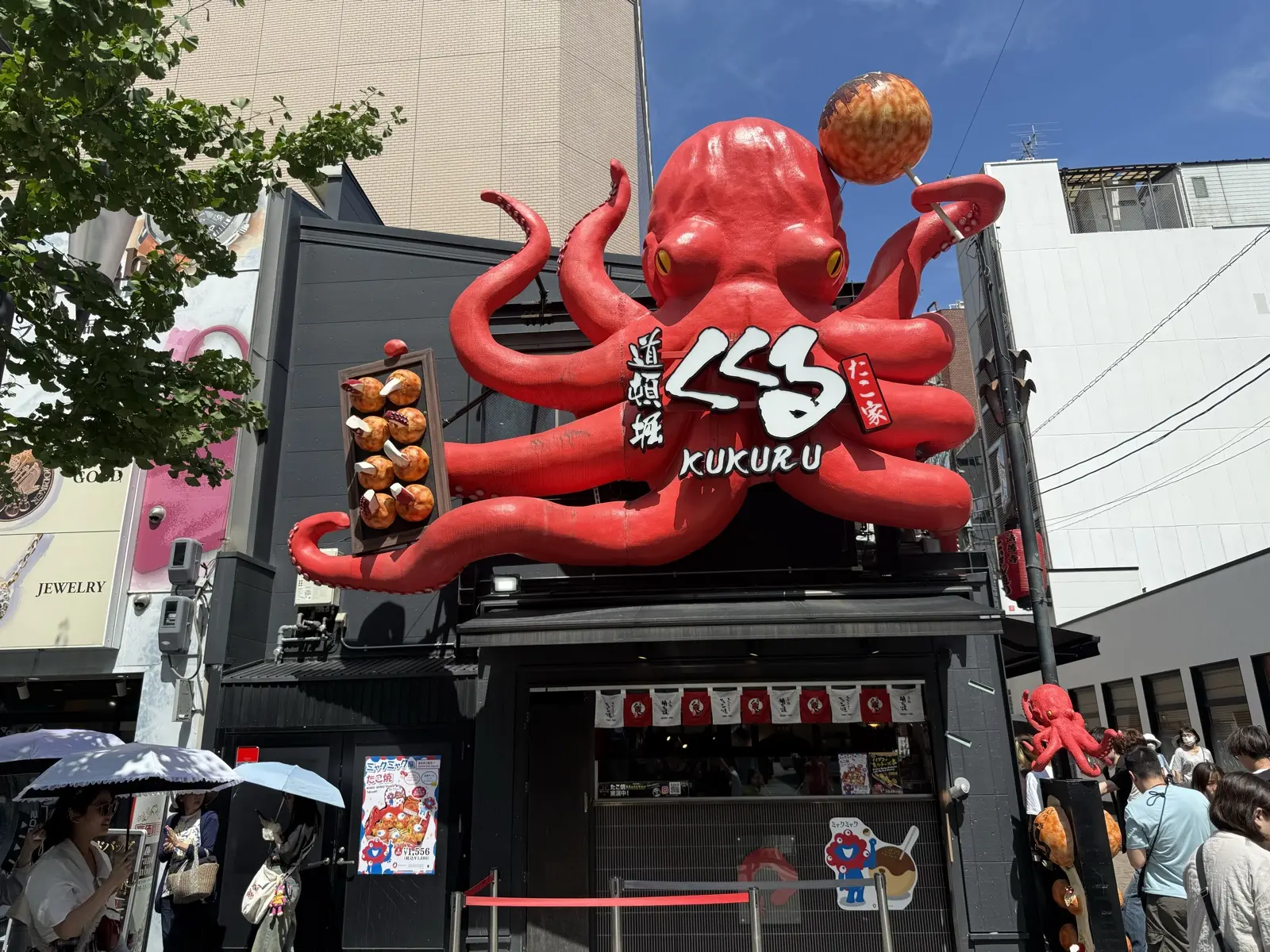
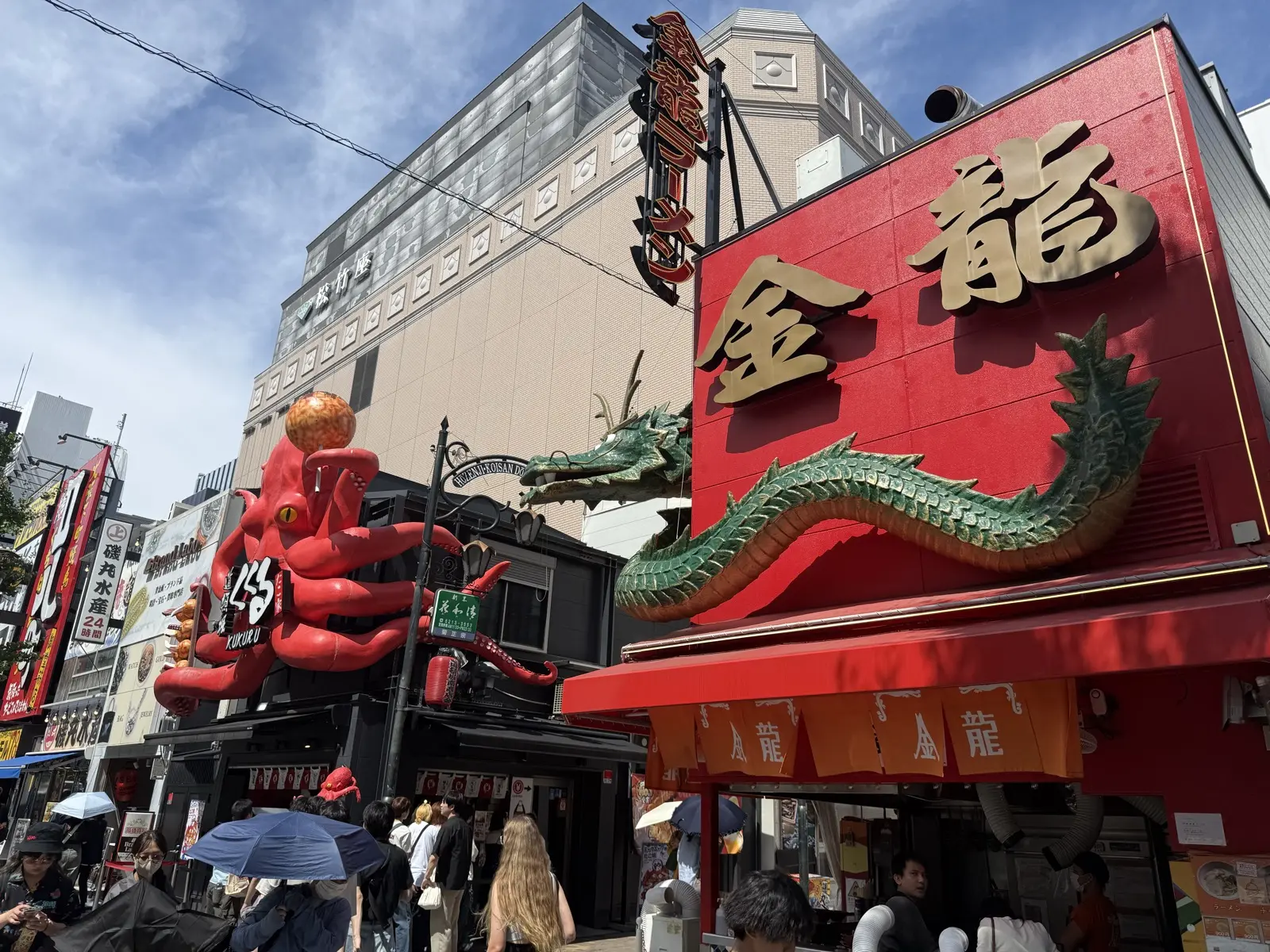
Takoyaki Kukuru (くくる) is the one with the giant red octopus grabbing the building — you cannot miss it, which is the point.
Takoyaki Juhachiban (十八番) is a popular stand that draws real queues; when I walked past today, the line said everything.
There are also plenty of smaller street stalls with menus and prices posted right out front — read them before you queue and you'll never get surprised. As a general rule, street takoyaki runs a few hundred yen up to around ¥1,000 for a portion; if a main-drag stall is asking a lot more than that, you've found the tourist premium.
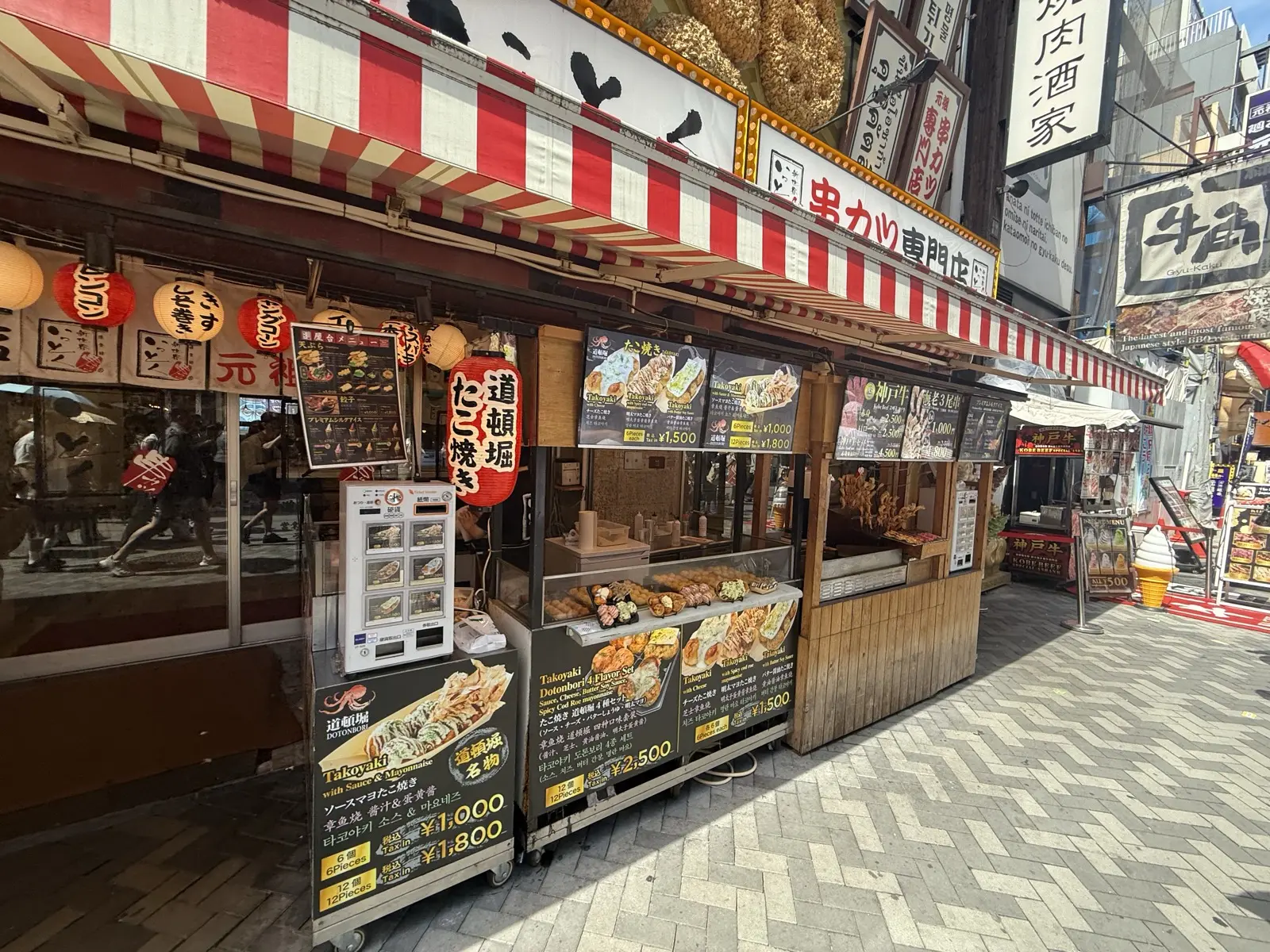
One tip locals give every visitor: takoyaki comes off the griddle molten. The outside cools fast; the inside is lava for a while. Wait a minute. Every year, tourists learn this the hard way.
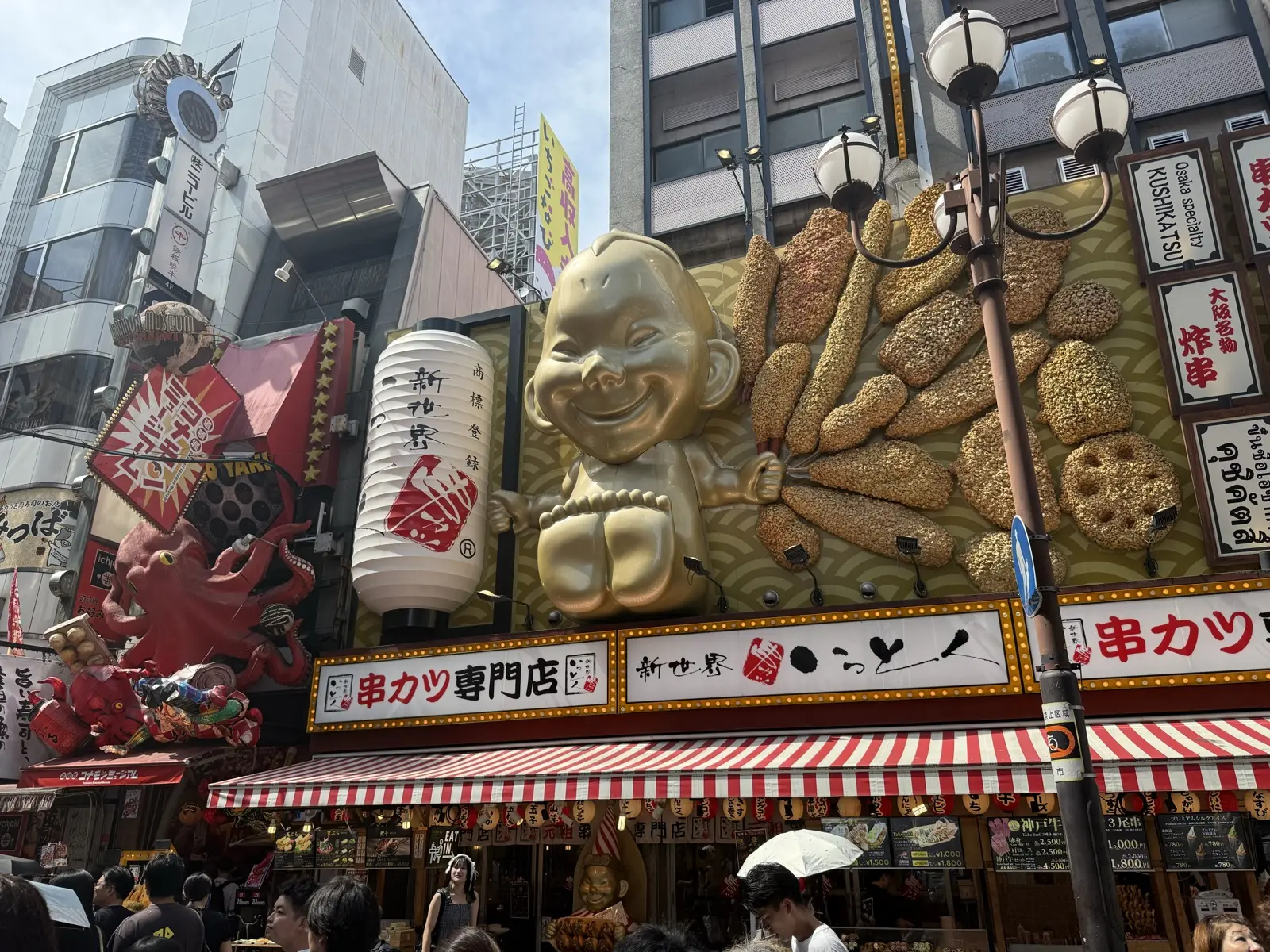
Kushikatsu is Osaka's other flag: skewers of meat, seafood and vegetables, breaded and deep-fried, dunked in a thin communal sauce. The famous name here is Kushikatsu Daruma (串かつだるま) — the chain with the angry-chef mascot glaring down at the street.
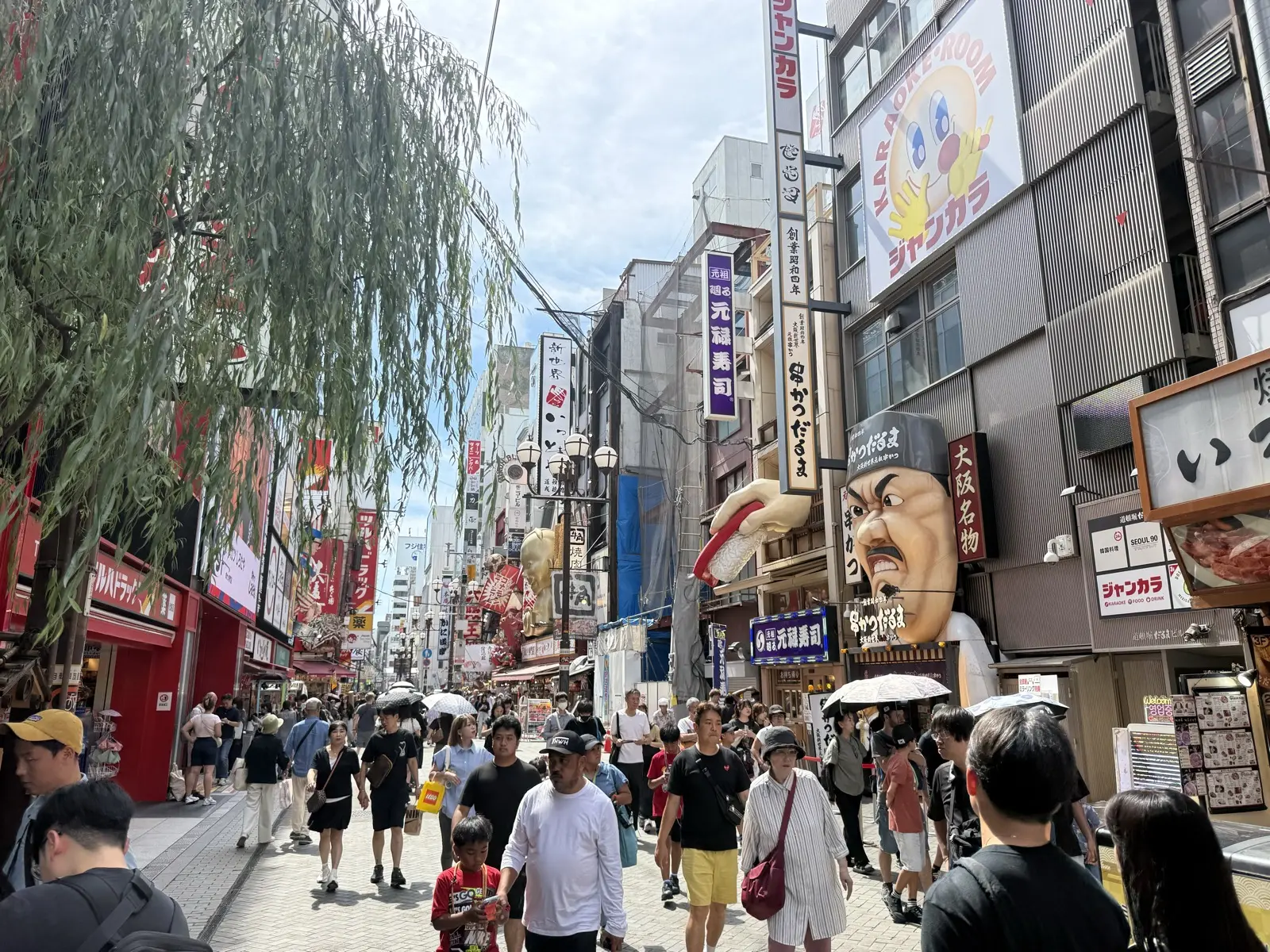
The rule, and it is sacred: no double-dipping. You dip your skewer in the shared sauce once, before your first bite — never again after your mouth has touched it. If you need more sauce, use the free cabbage as a scoop. Break this rule and you'll get The Look, deservedly.
You'll also spot a giant gold Billiken — Osaka's grinning good-luck god — perched over one of the kushikatsu shops. Rubbing his feet is the local custom for luck.
Kinryu Ramen (金龍), with the giant green dragon coiled over the storefront, is a Dotonbori landmark — open-air seating, right in the thick of it, as much a part of the streetscape as the Glico sign.
Useful for anyone who avoids pork: one Ichiran branch near Shinsaibashi/Namba advertises a pork-free ramen — a rare and genuinely helpful option in a food scene where pork broth hides everywhere. Be clear on what it is, though: it's pork-free, not halal-certified (it's made in the same kitchen as the regular tonkotsu, and the chicken and beef aren't certified either). For travellers who simply avoid pork it's a welcome option; strictly halal diners will want a certified restaurant instead. Confirm the details at the branch.
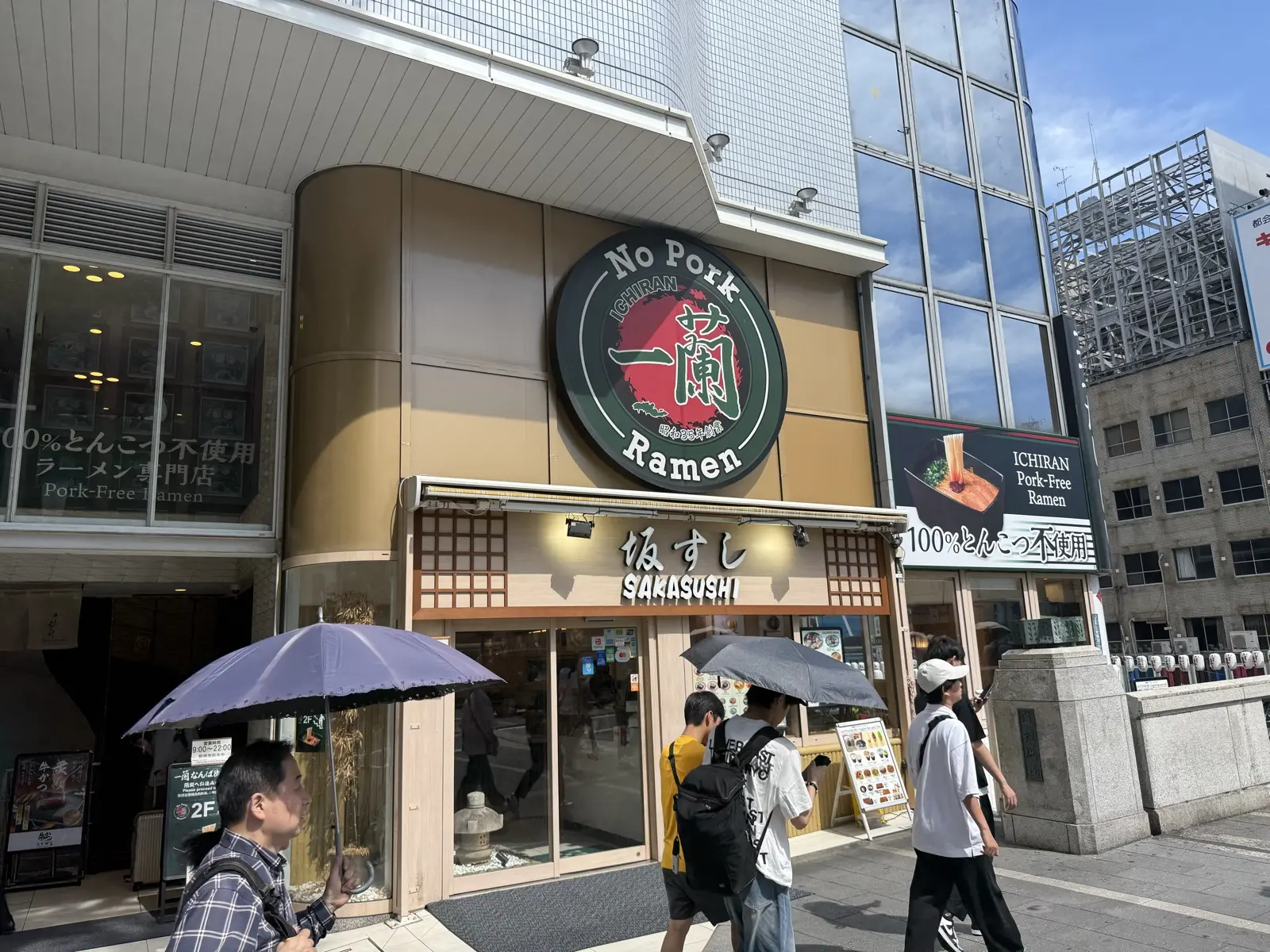
The blunt truth about Osaka street food: pork and dashi hide everywhere. Dashi made from bonito (fish) flakes is in takoyaki batter, okonomiyaki, most sauces and miso soup — so "vegetarian" takoyaki mostly isn't, even before the bonito flakes waving on top. Ramen broth is usually pork even when the toppings aren't. If you have a serious allergy, know that stall staff generally can't handle allergy questions in English; a written card in Japanese listing what you can't eat is the practical fix.
The workable options: the Namba area has a small number of halal-certified and vegetarian-friendly restaurants — few enough that you should look them up and pin them before you're hungry, not while you are. At least one halal ramen shop near Dotonbori goes further and provides a prayer space. And the quietly best tool is one this guide already mentioned: the Takashimaya depachika, where food is packaged and labelled, so you can actually read (or translate) what's in it instead of guessing at a stall window.
The streets branching off the canal — okonomiyaki joints like Botejyu, arcades, 3D signboards — are where the eating gets better value and the crowds thin slightly. My standing advice: pick one famous thing on the main drag for the spectacle, then do your actual eating a street or two away.
If you finish Dotonbori thinking "good, but I wanted more actual food and less neon," the answer is a ten-minute walk east. Kuromon Ichiba (黒門市場) is a covered fresh-food market off Sennichimae-dori, near Nippombashi Station — a long arcade of fishmongers, fruit stands and butchers that has become hugely popular with visiting foodies, for a simple reason: you can point at something raw and gorgeous and eat it grilled two minutes later.
This is the difference from Dotonbori's stalls. On the canal you're buying a famous snack from a famous signboard; at Kuromon you're buying from food shops — seafood over ice, wagyu skewers off the grill, fruit cut in front of you — and many stalls now let you eat right there on the spot. It's not a "local secret" any more (it's openly tourist-oriented these days, and priced accordingly at the flashiest stalls), but the food is real in a way a plastic octopus can't fake.
Two honest notes. First, bring cash — plenty of stalls are cash-only or clearly prefer it, and ¥500 coins are gold for exact change. Second, timing: the market runs roughly morning to early evening and is busiest (and fully alive) from mid-morning into the afternoon; the seafood is freshest early, and shutters start coming down if you leave it late. It slots perfectly before an evening Dotonbori — market for lunch, canal for the lights.
Can't type Japanese? Tap Open in Google Maps to navigate straight there, or Copy 日本語 to grab the Japanese name to show a taxi driver.
By train: Namba is served by the Midosuji subway line (from Umeda/Osaka Station, it's a straight shot south), plus Nankai, Kintetsu, Hanshin and JR Namba. From the airport, the Nankai line into Nankai Namba is the classic route. Tap in and out with an ICOCA card and don't overthink it — full details in our getting-around guide, and if you're doing multiple cities, check which pass actually fits your trip.
Timing: Morning Dotonbori is a different place — shuttered, quiet, almost eerie, great for photos with no crowds (but nothing to eat). The neon and energy peak in the evening, and so do the crowds and queues. My honest recommendation: do the Midosuji walk in the late afternoon, arrive at Dotonbori as the lights come on, eat, and let the night version happen around you.
Osaka is a genuinely safe city, but there is one real scam here and it works on tourists nightly. Around Dotonbori — and especially in Soemoncho, the nightlife strip just north of the canal — street touts (kyacchi, "catch") approach you with friendly English and an offer: cheap drinks, a great bar, pretty staff. The bars they walk you to hit you with an enormous surprise bill on the way out — "service charges" and "seating fees" that were never mentioned, sometimes running to tens of thousands of yen, with a bouncer between you and the door. This is the classic bottakuri (rip-off bar) trap. The rule is simple and absolute: never enter a bar someone on the street invited you into, and only drink where the prices are posted before you sit down. No legitimate place in Osaka needs to drag customers in off the street. Every spot in this guide, you walk into yourself.
Pace yourself: Kuidaore is a marathon, not a sprint. Two or three things eaten hot and standing up beat five things eaten cold in a queue.
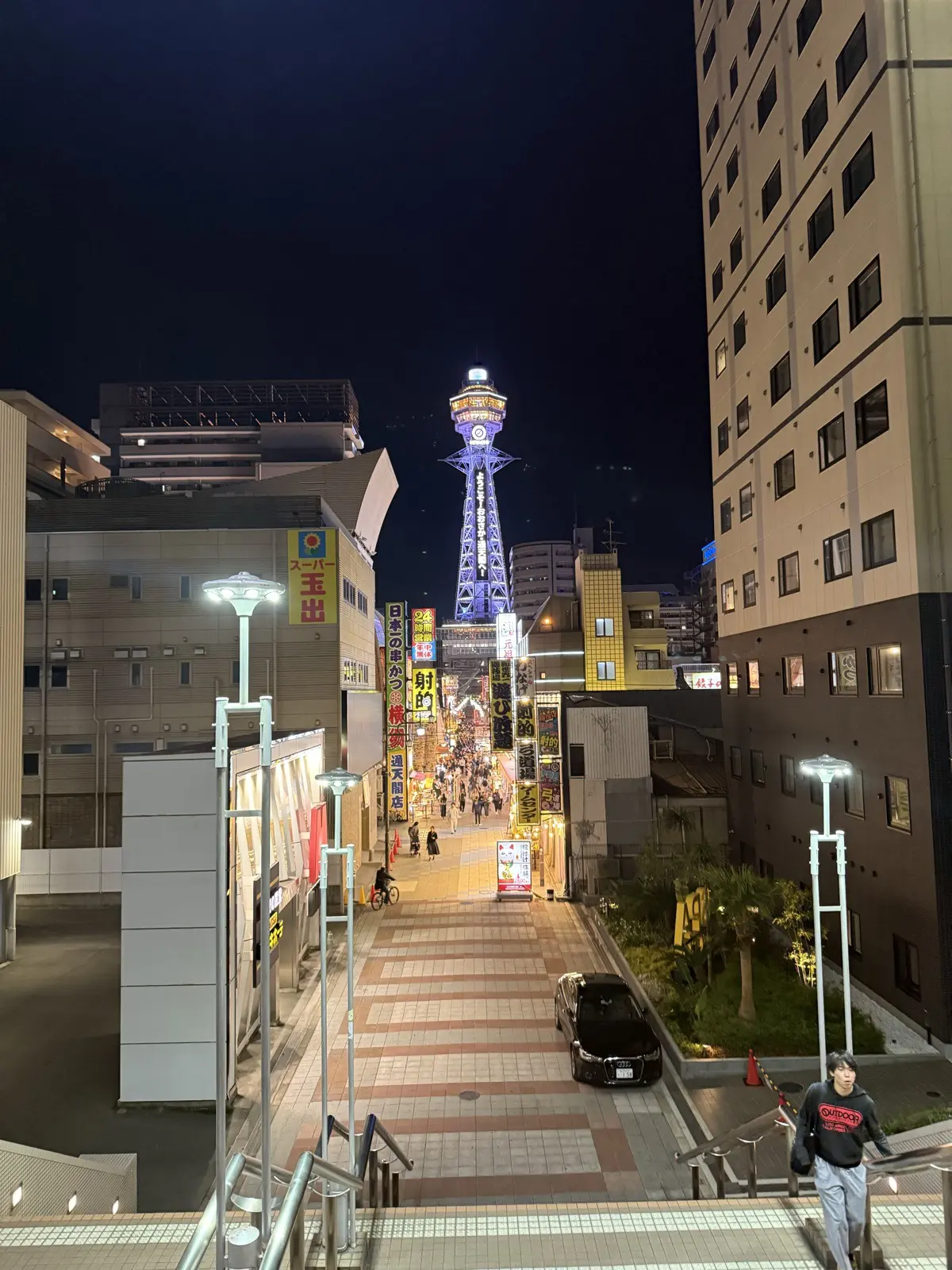
If Dotonbori leaves you wanting more of old, unpretentious Osaka, Shinsekai is a short hop south — a gloriously retro district built around the Tsutenkaku tower, and the spiritual home of kushikatsu. It's grittier and more fun than the polished canal; our full Tsutenkaku & Shinsekai guide has the details. You can grab the tower's observation-deck ticket ahead if you'd rather skip the queue:
Admission to the retro tower over Shinsekai — an easy add-on to a Dotonbori day, and you can book it before you go.
Tsutenkaku ticket on Klook →Dotonbori is the neon-lit canal district at the heart of Minami, southern Osaka — the city's famous food-and-entertainment strip. Yes, it's worth it: the Glico sign, the canal, and the street food are the definitive Osaka experience. Just go in knowing it's crowded and partly a spectacle, and you'll enjoy it a lot more.
Takoyaki (octopus balls) and kushikatsu (deep-fried skewers) are Osaka's two signatures, and Dotonbori has both everywhere. Get takoyaki hot from a stall — and let it cool a minute before biting. For kushikatsu, remember the one sacred rule: never double-dip your skewer in the communal sauce.
Walking it is completely free, including the Glico sign photo. The food ranges from cheap to inflated: the big-signboard stalls right on the main drag charge tourist prices, while shops a block or two off it are noticeably better value. It's a tourist magnet with real food underneath — trap status depends on where you stand in line.
Very — Ebisubashi bridge and the main street get shoulder-to-shoulder in the evening, which is also when the neon is at its best. Mornings are quiet and great for photos but most food stalls aren't going yet. The sweet spot is arriving in late afternoon and staying through dusk; keep your bag in front of you in the crush.
From Umeda, take the Midosuji subway line straight south to Namba — Dotonbori is a short walk from the station. From Kansai Airport (KIX), the Nankai line runs directly into Nankai Namba Station, right at the edge of the district. An ICOCA card covers all of it with a tap.
It takes some care — pork broth and dashi hide in a lot of Osaka classics, including most ramen and many takoyaki sauces. One Ichiran branch near Shinsaibashi/Namba advertises a pork-free ramen, useful if you avoid pork (note it's pork-free, not halal-certified). Department-store food halls like Takashimaya's basement also make it easier to read labels and choose carefully.
Not entirely, but carry cash. Many street stalls and small shops are cash-only or strongly prefer it, while chains, department stores and convenience stores take cards and IC cards like ICOCA without issue. The easy fix: pull yen from a 7-Eleven or post-office ATM (both take foreign cards) before you start eating.
Yes, if you're food-first — it's a covered fresh-food market about ten minutes' walk from Namba where you can eat seafood, wagyu skewers and fresh fruit right at the stalls. It's openly tourist-oriented these days rather than a secret, but the food is real. Go mid-morning to afternoon while it's fully open, and bring cash.
The ones inviting you into bars — yes, treat them as one. Around Dotonbori and especially Soemoncho, touts lead tourists into bars that add huge undisclosed charges to the bill. The rule that keeps you safe: never follow anyone who approaches you on the street, and only enter places with prices posted. Food stalls calling out to passers-by are normal and fine; it's the "come to my bar" pitch that isn't.