Home › Ohatsu Tenjin
Osaka · First-hand guide
Ohatsu Tenjin: Osaka's Love Shrine & Its Tragic Story
KBy Kai Sato · a 28-year Osaka local
Steps from Osaka Station, hidden between the Umeda high-rises, sits a shrine born from Japan's most famous tragic love story — and now one of the city's favourite spots to pray for love.
Officially it's Tsuyu no Tenjin Shrine (露天神社), a roughly 1,300-year-old shrine to Sugawara no Michizane, the deity of learning. But everyone calls it Ohatsu Tenjin (お初天神) — after a heroine — and that nickname is the whole reason it's worth knowing about.
In 1703, a courtesan named Ohatsu and a shop clerk named Tokubei, unable to be together, took their own lives in the shrine's wooded grounds. A month later, the great playwright Chikamatsu Monzaemon turned their story into the bunraku (puppet) play The Love Suicides at Sonezaki (Sonezaki Shinjū) — which became an enormous hit and remains a classic of Japanese theatre. The shrine has been known by the heroine's name, Ohatsu, ever since.
Because of that story, Ohatsu Tenjin has become one of Osaka's best-loved shrines for love and relationships — a designated "lovers' sanctuary." Couples and young visitors come to leave heart-shaped ema plaques and pick up matchmaking charms, and there's a bronze statue of the two lovers on the grounds.
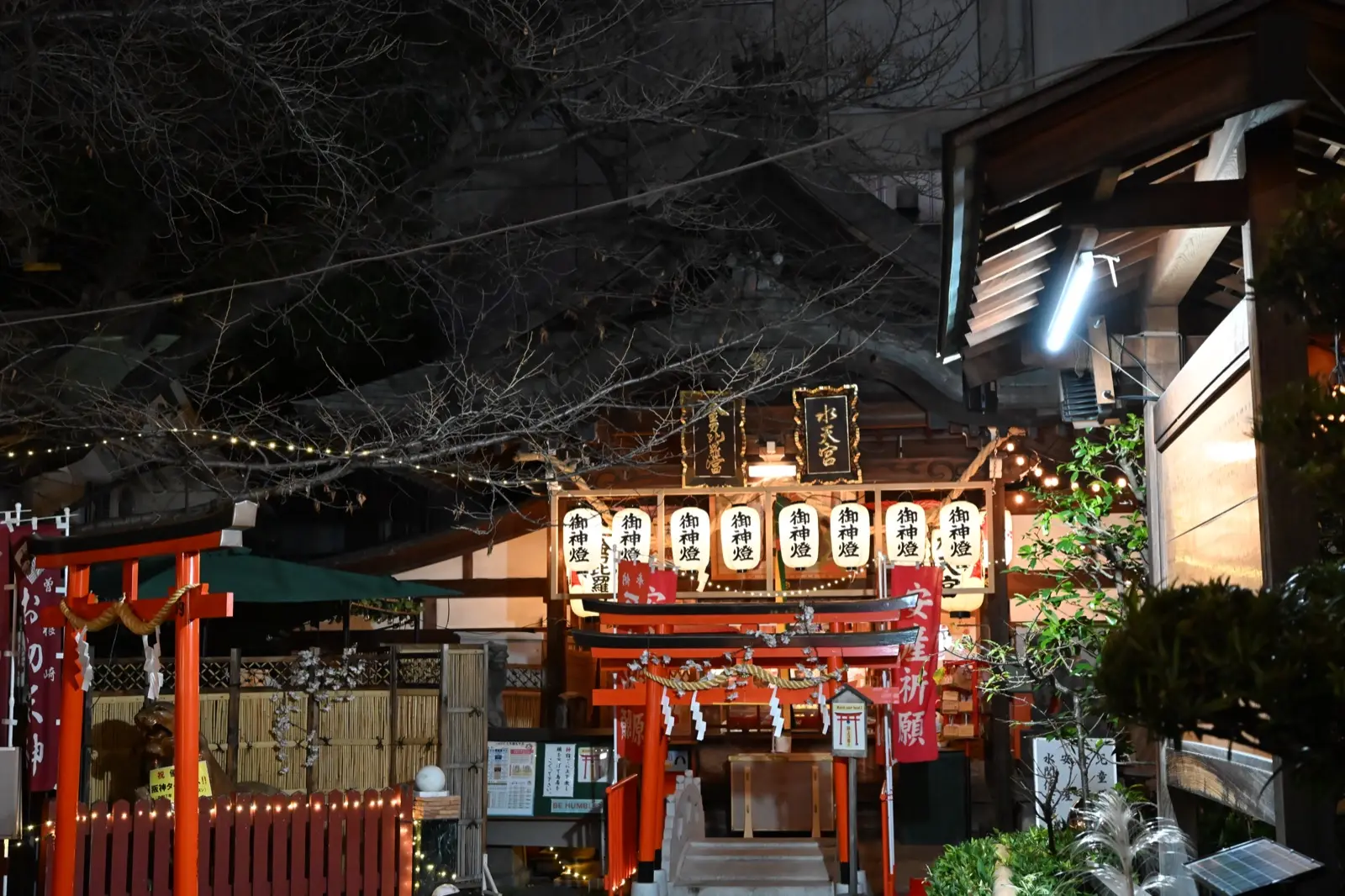
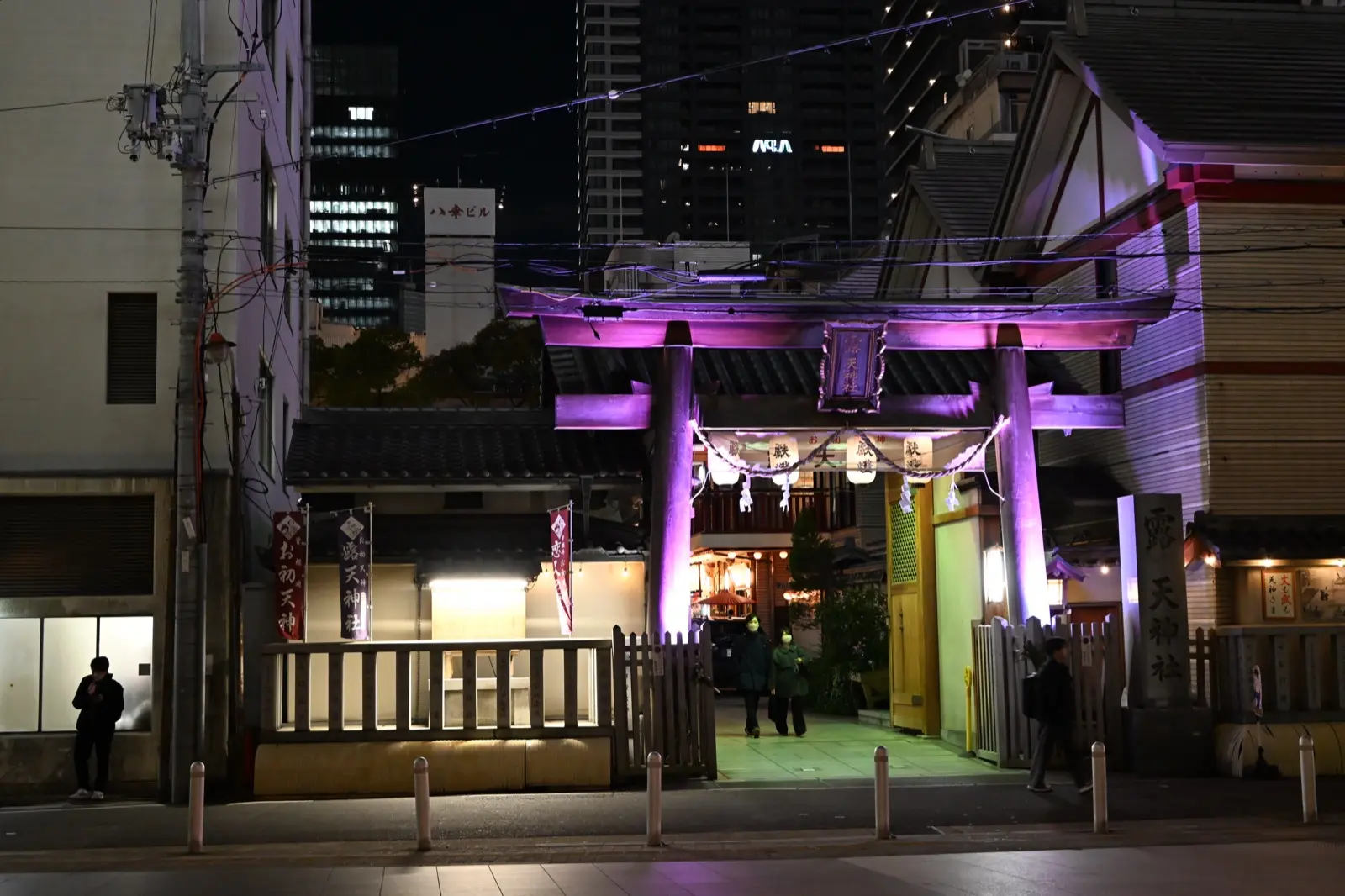
What makes it special is the contrast: you turn off a busy Umeda street and suddenly you're under an old wooden torii and paper lanterns, with office towers rising right behind the roofline. In the evening the main gate is lit, which is when it looks its best. It's compact but has more tucked inside than you expect — sub-shrines, the lovers' statue, rows of ema.
Because it's so close to Osaka/Umeda Station, it pairs naturally with a wider day in the area. It's a short walk from the shops and food around Osaka Station and the Tenjinbashi/Sonezaki backstreets.
This trips up a lot of visitors, so it's worth being clear. The shrine grounds are open daily from 6:00 to midnight, but the shrine office (jusho) — where charms, fortunes and the goshuin stamp are sold — only runs 9:00 to 18:00. That gap matters. Show up at 8:00 for a quiet photo of the bronze statue and empty approach: fine, the gates are open. Show up at 21:00 expecting to buy a love charm or draw the famous water fortune: the office is shut and you'll leave empty-handed.
The honest planning tip: if the charms, ema or goshuin are the reason you're going, arrive before 17:30 to leave buffer. If you just want the atmosphere and photos, early morning (before 8:00) is the calmest window — the surrounding Sonezaki arcade is a late-night district, so evenings bring foot traffic and drinkers cutting through, not serenity.
Entry is free, but this is a shrine where the small paid items are the whole point of coming. The prices below are verifiable at the shrine office.
| Item | Price (incl. tax) | Note |
|---|---|---|
| Koi-mikuji (love fortune slip) | 200 yen | The signature draw |
| Heart-shaped ema (wish plaque) | 800 yen | Pink, printed with Ohatsu & Tokubei |
| Omamori (love charms) | ~500–1,000 yen | Range; special designs cost more (verify) |
| Goshuin (stamp) | Typically 300–500 yen | Bring a goshuincho; price (verify) |
The koi-mikuji has a trick most people miss: the slip prints blank, and you float it in water at the shrine to make the fortune appear. If someone hands you what looks like an empty fortune, it isn't defective — you're meant to dip it. It's the single most photographed ritual here, and at 200 yen it's the cheapest reason the shrine earns its "love shrine" reputation.
The shrine sits at the end of the Sonezaki Ohatsu Tenjin-dori, a roughly 300-metre covered arcade with more than 100 restaurants — this is what makes the shrine a genuinely good use of an hour rather than a five-minute detour. It's a retro, Showa-era food street, not a polished tourist strip.
The practical move: do the shrine (free, ~15–20 min), then eat in the arcade. It's cheaper and more local than the department-store restaurant floors around Osaka/Umeda Station, and it's a 3–6 minute walk from the same stations, so you lose nothing on convenience.
Address: 2-5-4 Sonezaki, Kita-ku, Osaka. It's boxed in by stations, which is why it's one of the most accessible shrines in the Umeda/Kita area: roughly a 3-minute walk from Higashi-Umeda (Osaka Metro Tanimachi Line), and about 5–6 minutes from Hankyu Osaka-Umeda, JR Osaka and Kita-Shinchi stations. The catch: Umeda's station complex is a notorious maze, so navigate to a street-level exit (the Tanimachi Line's Higashi-Umeda exits are the most direct) rather than trusting a straight-line map through the underground.
Flea market: held on the first Friday of every month, with roughly 30–40 second-hand and antique stalls (pottery, Showa-era goods, retro items). Note that some listings claim first and third Fridays — the official Osaka tourism source states first Friday only, so treat the third-Friday claim as unconfirmed and check ahead. Daytime is when the stalls are set up.
Seasonal note: the area's big event is the citywide Tenjin Matsuri (July 24–25), one of Japan's three great festivals — but that is centered on Osaka Tenmangu, a different shrine, not Ohatsu Tenjin. Don't come here on those dates expecting the boat processions; that's a common mix-up.
Is it worth going out of your way for? The honest answer: not as a standalone destination. It's worth it as a 20-minute stop bundled with eating in the arcade or while you're already in Umeda — the combination is the value, not the shrine alone.
Is it good with kids? It's small, free and central, so a short visit is easy, but there's little for children specifically. The adjacent arcade (with game centres and food) holds their attention better than the shrine.
Is it wheelchair-friendly? It's among the more accessible shrines in the Kita/Umeda area — flat, central, short walks from step-free stations — but specific barrier-free toilet details at the shrine itself aren't confirmed; phone ahead (06-6311-0895) if that's essential.
Can couples do a ritual together? Yes — the heart-shaped ema and koi-mikuji are the popular couple activities, and it's a recognised enmusubi (matchmaking) spot.
How long should I budget? 15–20 minutes for the shrine; add 30–60 minutes if you eat in the arcade.
The popular name for Tsuyu no Tenjin Shrine, a ~1,300-year-old Umeda shrine to Sugawara no Michizane (deity of learning), famous as a love shrine because of a 1703 double love-suicide in its grounds that became Japan's most famous puppet play.
After Ohatsu, the heroine of the 1703 tragedy. She and her lover Tokubei died together here; Chikamatsu Monzaemon dramatised it as The Love Suicides at Sonezaki, and the shrine took her name.
Free to visit the grounds. It's an open urban shrine, and it looks best in the evening when the torii is lit.
Sonezaki, Umeda — about 5 minutes on foot from Higashi-Umeda Station (Tanimachi Line) and ~10 minutes from JR Osaka Station.
For a free, atmospheric, story-rich 15–20 minute stop right by Osaka Station, yes — especially if you like the tale or want a matchmaking charm. It's compact, so set expectations accordingly.